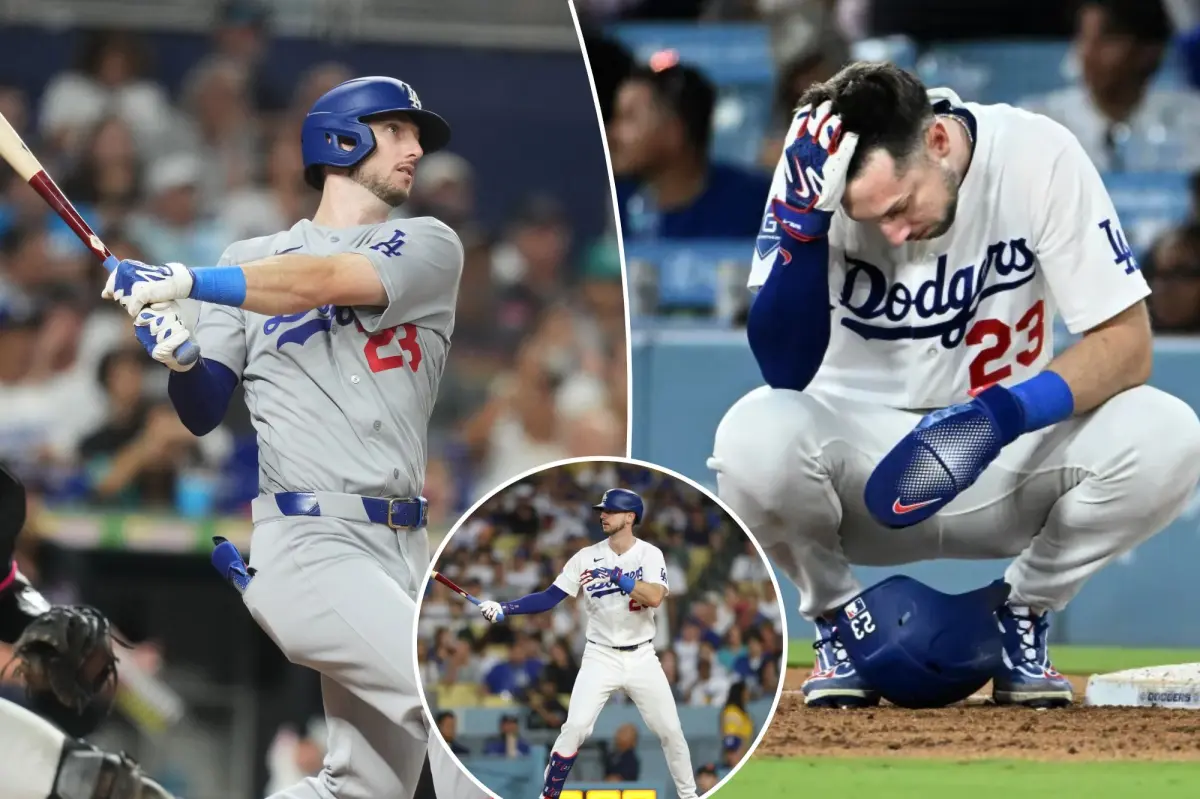
CINCINNATI — With his career-worst season spiraling into nightmare territory, Los Angeles Dodgers outfielder Kyle Tucker was pulled aside recently by manager Dave Roberts for a candid conversation about his playing time for the remainder of the year.
External Pressure vs. Internal Faith
Externally, calls had been mounting for the $240 million free-agent signing to be platooned or outright benched as his offensive numbers continued to plummet during an extended second-half slump. Internally, however, the Dodgers’ front office and coaching staff decided to double down on their faith in this offseason’s marquee acquisition.
The message Roberts delivered was unambiguous.
“I told him, I’m gonna ride or die with him,” Roberts shared this weekend.
Asked if he used that exact phrasing, Roberts smiled.
“I did,” Roberts joked. “That was my young term phrase.”
Glimmers of Progress Amid Persistent Struggles
On the day of those comments, Roberts had reason for optimism. Over the previous two games, Tucker had shown signs of life at the plate, posting back-to-back three-hit performances that included a home run. Over the preceding week, Dodgers hitting coaches believed they had finally identified a mechanical breakthrough with the left-handed slugger’s swing — one that temporarily cleaned up flaws that had plagued him all season.
But in Tucker’s 2026 campaign, no turnaround has proved simple.
Over the two games following that brief surge, he went 0-for-8, including a strikeout with the bases loaded in the top of the ninth inning on Sunday. For the season, his numbers remain stunningly disappointing: a .226 batting average, a .692 OPS, and a nearly negligible 0.3 wins above replacement.
A Season on the Brink of Historic Flop Territory
At this point, the 29-year-old four-time All-Star is threatening to become one of the biggest free-agent busts in recent high-priced MLB history. Yet the Dodgers are not wavering from their commitment to keep the veteran in the lineup, citing his “talent level” and “proven track record,” as Roberts noted.
“I was prepared, the organization was prepared, to give him as much leash as we possibly could to work through some things, and I do think that now we’re starting to see the fruits,” Roberts said. “So I see no other reason why we would pivot from running him out there every day.”
The only caveat Roberts offered:
“I guess, to that same point, until you can’t, right?”
Diagnosing a Mechanical Mystery
Pinpointing the root cause of Tucker’s dismal season has been as difficult as reading his emotions behind a stoic, reserved facade. The one point of consensus among the coaching staff: the issue is entirely mechanical.
“It’s purely mechanical,” co-hitting coach Robert Van Scoyoc told the California Post recently. “His swing plane is pretty unique, but it’s just not working the way that it used to.”
The problem, as Tucker himself conceded last month, has been finding an adjustment that sticks.
“I feel like I’ve tried just about everything,” he said. “And every time I feel like I’m turning a corner, I get hit with a roadblock.”
Tucker’s swing has always been atypical — both in the way he “lays the bat back” in his stance (which, according to fellow hitting coach Aaron Bates, creates a longer path and “a smaller margin for error”) and how he strides through the ball, launching off his back foot with an almost Scottie Scheffler-esque follow-through.
When synchronized, the mechanics make him one of the game’s most consistent hitters, drawing comparisons from some evaluators to a modern-day Ted Williams. When out of sync, the results are catastrophic.
“I think it’s a slippery slope,” Bates said.
Statcast Data Confirms the Decline
According to MLB’s Statcast system, Tucker’s rate of “barreled” balls has fallen nearly in half — from 10.8% last year (and 12.9% in 2024) to just 6.3% this season.
For much of the year, Bates said, Tucker struggled to replicate his old inside-out swing path. Instead, he was “cutting down and across the ball,” preventing him from squaring up fastballs or adjusting to off-speed pitches.
The coaching staff’s initial fix involved cycling Tucker through old drills and mental cues that had worked earlier in his career. This time, those familiar remedies failed, leaving a player who once always had offensive answers searching for solutions.
Searching for the ‘Why’ Behind the Regression
Why the old fixes stopped working still confounds the Dodgers. Theories range from a slow adjustment to his new organization to potential lingering effects from the hand fracture he played through last season with the Chicago Cubs.
“It definitely seems like things kind of shifted after [that],” Van Scoyoc said, noting that Tucker also struggled down the stretch in 2025. “So it could be that, but it might not be. We don’t exactly know.”
The clarity that emerged was the need for a new approach. That realization sparked constant trial-and-error during Tucker’s elongated batting-cage sessions in recent weeks.
A Potential Breakthrough: The ‘No-Roll Swing’
Last week, something finally clicked. As Bates described it, Tucker found comfort with the concept of a “no-roll swing” — where instead of flipping his hands at the end of his follow-through, he keeps them more square to the big part of the field.
“Guys who throw right-handed but hit lefty, it’s something they struggle with sometimes, because the right side of their body is the dominant side,” Bates said, noting that the team has made similar adjustments with Tommy Edman, Alex Freeland and Dalton Rushing this season.
In Tucker’s case, the cue helped flatten his swing plane.
“He was missing pitches he thought he needed to get on top of,” Bates said, “and needed to think about swinging high instead of swinging down.”
The adjustment has also kept his barrel in the hitting zone longer, allowing him to readjust to off-speed offerings — one of his career strengths — while better squaring up mistakes left over the plate, like the hanging inside sweeper he drove for a grand slam on Friday.
“There’s a lot more room for error hitting the ball, because you can hit it deep and go the other way or catch it out in front and pull it a little bit more,” Tucker explained. “Just trying to be consistent with that and be as long through the zone as possible.”
Playoff Validation Remains the Ultimate Goal
Whether the adjustment proves to be a genuine breakthrough or another false start in a season that never gained traction, the Dodgers are willing to invest the time to find out. After all, while Tucker’s regular season is beyond salvaging, Van Scoyoc maintained that “he can find it in one swing and then go on a run.”
Thus, they will “ride or die” with him the rest of the way, despite the dismal struggles of the last five months.
“I mean, the numbers probably are what they are, but we’ve got a lot of important games coming next month,” Tucker said, eyeing what he hopes will be validation in the playoffs. “That’s the most important thing … As long as you win the game and kind of contribute to that in some way, that’s all you can really try and do.”
Added Roberts:
“If you perform at the right time, all is forgotten.”