Key Highlights
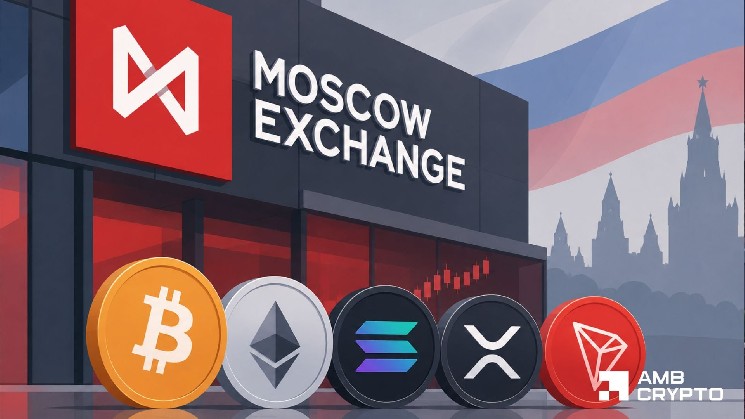
- Moscow Exchange (MOEX) launches perpetual futures on Bitcoin, Ethereum, Solana, Ripple, and Tron indices for qualified investors on September 22.
- The exchange’s existing crypto derivatives market has attracted over 72,000 qualified investors and recorded volumes exceeding 600 billion Rubles since its summer 2023 debut.
- Retail investors remain excluded from crypto derivatives despite Russia permitting retail spot crypto trading, concentrating liquidity among professional accounts.
MOEX Broadens Regulated Crypto Derivatives Suite with Perpetual Futures
Moscow Exchange (MOEX) is significantly expanding its regulated cryptocurrency derivatives offering, responding to growing demand for institutional-grade digital-asset exposure within Russia. Beginning September 22, qualified investors will gain access to perpetual futures contracts linked to indices tracking Bitcoin (BTC), Ethereum (ETH), Solana (SOL), Ripple (XRP), and Tron (TRX). The move adds a new structural layer to a marketplace that has already onboarded more than 72,000 qualified investors since its initial crypto futures launch in summer 2023, generating cumulative trading volumes surpassing 600 billion Rubles.
Perpetual Structure Removes Daily Rollover Friction
The newly announced perpetual contracts are designed to renew automatically on a daily basis, eliminating the requirement for traders to close positions at the end of each trading session. This structural feature makes the instruments substantially more suitable for continuous hedging and speculative strategies compared to traditional fixed-expiry futures, which demand repetitive position rollovers. By reducing operational friction, MOEX aims to capture trading activity that might otherwise migrate to offshore venues offering similar perpetual products.
Professional-Only Access Shapes Liquidity Profile
A critical constraint on market development is the professional-only access framework. Retail investors are barred from trading these derivatives, concentrating liquidity exclusively among qualified accounts. This restriction persists even as Russia has separately opened spot cryptocurrency trading to retail participants while maintaining a ban on crypto payments. The qualified-investor requirement creates a dual dynamic: it ensures a baseline of institutional-scale participation but simultaneously caps the potential depth of the order book by excluding the broader retail cohort.
Broker participation emerges as a pivotal variable. As intermediaries responsible for onboarding qualified accounts, brokers function as the primary growth lever for expanding the trader base without altering the regulatory perimeter. Should broker engagement accelerate, MOEX could see materially higher derivative volumes while the retail restriction remains in force.
Why This Matters
The September 22 launch serves as a real-time test of whether Russia’s professional crypto derivatives market can achieve self-sustaining depth. Bitcoin and Ethereum contracts are expected to capture the lion’s share of early volume given their established demand profile; meaningful participation in Solana, XRP, and Tron perpetuals would signal genuine market broadening beyond the two largest assets. Market observers will monitor open interest trajectories alongside sustained volume—rising open interest with consistent turnover would indicate deepening positioning, while a post-launch activity fade would suggest the expansion adds product breadth without materially improving market liquidity. The outcome will inform whether MOEX can establish itself as a durable onshore venue for institutional crypto risk management or remains a niche segment dependent on a limited pool of qualified capital.
Frequently Asked Questions
Who can trade the new MOEX perpetual crypto futures?
Only qualified investors as defined under Russian securities regulations may trade the new perpetual futures. Retail investors are explicitly excluded from these derivative products, even though Russia permits retail participation in spot cryptocurrency trading.
What cryptocurrencies are covered by the new perpetual contracts?
The launch includes perpetual futures linked to indices for Bitcoin (BTC), Ethereum (ETH), Solana (SOL), Ripple (XRP), and Tron (TRX).
How do perpetual futures differ from the existing MOEX crypto futures?
Perpetual futures renew automatically each day and do not require traders to close or roll over positions at expiry, unlike traditional fixed-maturity futures. This structure supports continuous hedging and speculation without daily operational interruption.