Top 10 Most Successful Formula 1 Engine Manufacturers of All Time
Ferrari stands as the most iconic team in Formula 1 history, defined by its scarlet liveries and a roster of legendary drivers. However, Mercedes has now drawn level at the summit of the most successful power unit manufacturers, matching Ferrari’s tally of 251 Grand Prix victories following Kimi Antonelli’s win at the 2026 Spanish Grand Prix.
From these two motorsport powerhouses to defunct giants like Coventry Climax and BRM, here are the top 10 engine producers with the most Formula 1 wins across 76 years of championship racing.
1. Ferrari – 251 Wins
Ferrari has contested every Formula 1 season since the inaugural championship in 1950, amassing vast success over the decades with drivers such as Alberto Ascari, Niki Lauda, and Michael Schumacher. The Scuderia has secured a colossal 251 victories with its own power units. Charles Leclerc celebrated the team’s 250th win at the 2026 British Grand Prix, while the additional victory came courtesy of Sebastian Vettel’s maiden triumph for Toro Rosso in 2008, when the team operated as a Ferrari customer.
Ferrari’s very first Grand Prix victory belonged to José Froilán González, known as the “Pampas Bull.” He joined the squad for five rounds in 1951, finishing on the podium at every appearance, including a win at Silverstone.
1. Mercedes – 251 Wins
Mercedes competed in only two Formula 1 campaigns (1954 and 1955) before a lengthy sabbatical. The manufacturer returned in the mid-1990s as an engine supplier for Sauber and McLaren, later adding Brawn GP and Racing Point to its customer roster. The original stint yielded two Drivers’ Championships for Juan Manuel Fangio, but the modern era of dominance stems from McLaren’s Mika Häkkinen (1998, 1999 World Champion), Brawn GP’s Jenson Button (2009 World Champion), and the full works re-entry in 2010.
After returning as a constructor with Michael Schumacher and Nico Rosberg, Mercedes required two years to win a race and another two to claim a first title. By then, Lewis Hamilton had joined the team, going on to claim 85 of Mercedes’ total victories. Rosberg, Kimi Antonelli, Valtteri Bottas, and George Russell have also contributed to the record tally.
3. Ford Cosworth – 176 Wins
The Cosworth DFV ranks among the most dominant engines in F1 history, delivering 155 wins across outfits including Team Lotus, Brabham, Tyrrell, and Williams. Between the 1960s and 1980s, it was the default choice for any team not building its own power unit. Jim Clark secured its maiden victory at the 1967 Dutch Grand Prix, driving from eighth to first in the Lotus 49. A testament to its supremacy: every single race in the 1969 and 1973 seasons was won by a DFV-powered car.
The turbo era forced an evolution, with later Ford Cosworth variants adding 21 further wins. These came predominantly via Benetton and McLaren, though Giancarlo Fisichella claimed the final victory for Jordan at the 2003 Brazilian Grand Prix.
4. Renault – 169 Wins
Renault pioneered the regular use of turbocharged engines in Formula 1. After two seasons of severe reliability issues—it took 14 races to record a first finish—the breakthrough arrived in 1979. Jean-Pierre Jabouille, who had endured every prior retirement, won the French Grand Prix that year. Alain Prost’s arrival in 1981 unlocked the program’s potential, yielding nine wins before the works team declined and withdrew in 1986.
Ironically, greater success followed the 1989 ban on turbos when Renault began supplying Williams. Subsequent partnerships with Benetton and Red Bull lifted the total to 169 victories, with Esteban Ocon scoring the final win at the 2021 Hungarian Grand Prix. Renault departed F1 again at the end of the 2025 season, prompting Alpine to switch to Mercedes power for the 2026 regulations.
5. Honda – 89 Wins
Honda’s F1 history is fractured across four separate stints, beginning in 1964. Early success came quickly as Richie Ginther won the 1965 Mexican Grand Prix in a Honda-built chassis and engine. The manufacturer returned as a supplier for Spirit, Williams, Lotus, McLaren, and Tyrrell between 1983 and 1992. While factory support varied, Nigel Mansell, Nelson Piquet, Ayrton Senna, and Alain Prost all proved Honda could provide an unbeatable power unit.
Financial reasons triggered a withdrawal before Honda purchased BAR, which became Brawn GP when Honda exited again amid the 2008 economic crisis. A fruitful partnership with Red Bull began in 2019, with Max Verstappen delivering the first win of the V6 turbo-hybrid era. The tally reached 89 victories, the last coming at the 2021 Abu Dhabi Grand Prix, though this was far from the end of Honda’s involvement in the sport.
6. Coventry Climax – 40 Wins
Coventry Climax had manufactured engines since the early 20th century but entered racing in the 1950s. Stirling Moss scored their first win at the 1958 Argentine Grand Prix, though the standard 2-litre unit lacked the power to challenge rivals consistently. A 2.5-litre version arrived in 1959, propelling Jack Brabham to the World Championship. The engine proved versatile across Lotus, Cooper, Brabham, and Lola chassis, securing 40 Grand Prix wins between 1958 and 1965.
The program bowed out in style when Jim Clark secured his third career Grand Slam at the 1965 German Grand Prix en route to the title. Coventry Climax left motorsport when the 3-litre formula was introduced.
7. Honda RBPT – 38 Wins
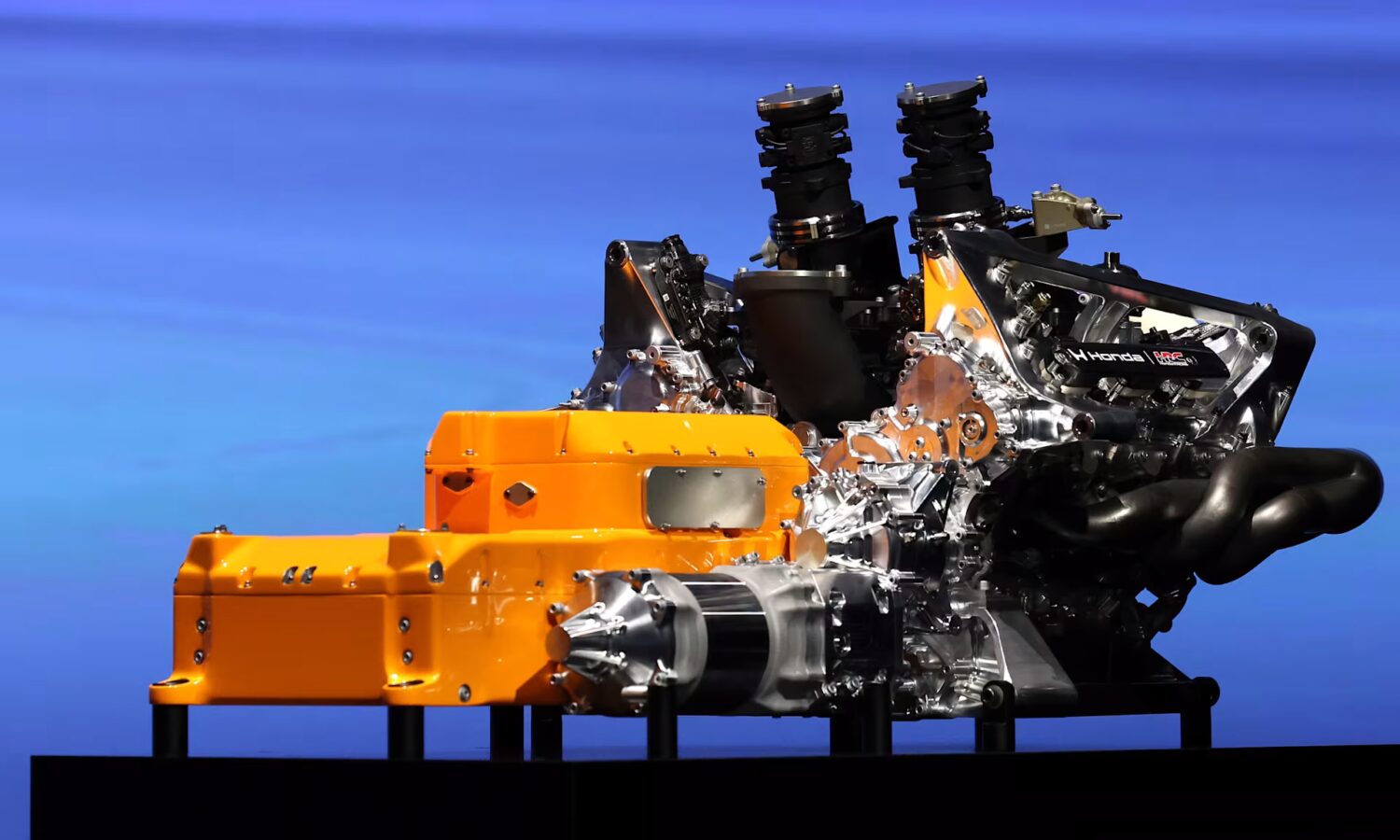
Max Verstappen’s hard-fought 2021 Drivers’ Championship coincided with Honda’s official departure, but the manufacturer agreed to support Red Bull’s transition to in-house production under the Red Bull Powertrains (RBPT) banner. A new agreement transferred the Honda engine IP to Red Bull through the end of the 2025 season, with Honda providing technical support as required.
This arrangement yielded one of the most dominant seasons in recent memory, as Red Bull won all but one race in 2023, amassing 860 points. While 2024 and 2025 were less productive, the partnership concluded with 38 victories overall, placing seventh on the all-time list.
8. TAG Porsche – 25 Wins
Short-lived but immensely successful, the TAG-funded Porsche engine powered McLaren from 1983 to 1987. Originally slated for a 1984 debut, Niki Lauda insisted on early testing, forcing a modified chassis for the 1983 Dutch Grand Prix. The unit was effective immediately: Alain Prost won the season-opening 1984 Brazilian Grand Prix, though Lauda claimed that year’s title. The duo combined for 25 victories before McLaren switched to Honda in 1988, inspired by the Japanese manufacturer’s strong showings with Williams.
9. BMW – 20 Wins
BMW’s early F1 involvement consisted of sporadic private entries, but the 1980s saw a full commitment to challenge Renault’s turbo dominance. After an initial exclusive deal with Brabham faltered—Bernie Ecclestone’s team initially preferred Cosworth—Nelson Piquet delivered BMW’s first win at the 1982 Canadian Grand Prix.
The 1989 ban on turbos paused BMW’s involvement. The manufacturer later replaced Renault at Williams, delivering a competitive engine for 2000 and a more aggressive evolution that won the 2001 San Marino Grand Prix. By 2003, Williams consistently fought for wins but could not match Ferrari’s dominance, ending the partnership in 2005. BMW’s subsequent purchase of Sauber yielded only one victory—Robert Kubica at the 2008 Canadian Grand Prix—before the team was sold back to Peter Sauber.
10. BRM – 18 Wins
British Racing Motors (BRM) endured a shaky start as overly ambitious engines failed to deliver results. Delayed development eventually yielded a first win for Jo Bonnier at the 1959 Dutch Grand Prix. Partner Alfred Owen threatened to cancel the project without improvement, promoting former Rolls-Royce employee Tony Rudd to Chief Development Engineer—a masterstroke. Rudd resolved fundamental issues, culminating in Graham Hill’s 1962 Drivers’ Championship.
BRM also sold engines to privateers, but performance faded, and the marque exited F1 in 1977 with 18 Grand Prix victories: 17 as a works team and one via Team Lotus.