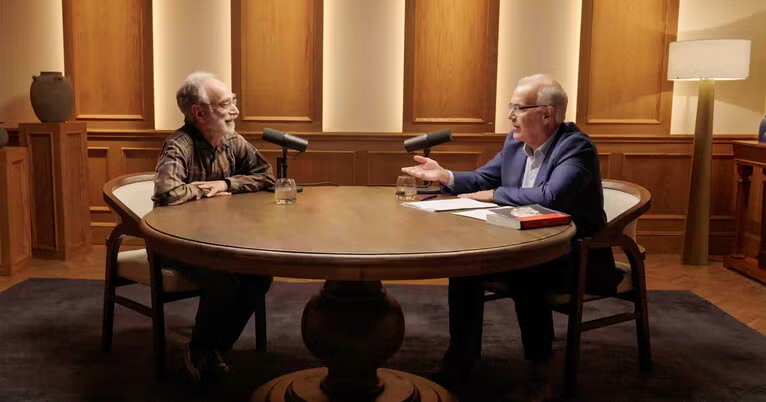
David Brooks, Presidential Senior Fellow at the Yale Jackson School of Global Affairs and staff writer for The Atlantic, launched a new weekly video podcast today titled The Permanent Questions. Produced by The Atlantic in partnership with Yale, the series features conversations with academics, teachers, and experts exploring fundamental questions of the humanist tradition, inviting listeners to reflect deeply on the purpose and meaning of their lives.
Yale Leadership Welcomes the Initiative
Yale President Maurie McInnis expressed enthusiasm for the project:
“I’m excited to see how David and his guests will welcome the public into the questions and conversations being pursued at Yale,” said Yale President Maurie McInnis. “Everyone has a stake in the enduring quandaries of the human condition. I have no doubt that this podcast will inspire people from all walks of life to participate in the endless work of asking questions, seeking answers, and deepening human knowledge.”
Brooks holds the inaugural Presidential Senior Fellow position, a program McInnis established to bring experts to campus who encourage respectful debate and bridge the academy with broader society. The five-year appointment began February 1, with a mandate to expand public access to the transformative work of universities.
Expanding Public Engagement with the Liberal Arts
As part of his role, Brooks is developing programming to increase public engagement with the liberal arts. Beyond the podcast, this includes a series of popular talks first hosted on campus last spring that have since found a wider audience online. The next two talks are scheduled for September 22 and December 1, with pre-registration required.
Brooks brings extensive experience as the author of seven non-fiction books covering ethics, neuroscience, sociology, and psychology. He served as an op-ed columnist for The New York Times for 22 years and contributes regularly to PBS NewsHour. His essays for The Atlantic examine major shifts in governments, institutions, and social structures. He previously served as a senior fellow at the Yale Jackson School from 2012 to 2018 and again from 2021 to 2022.
“David has always had a gift for making complex ideas feel urgent and personal,” said James Levinsohn, the Charles W. Goodyear Professor of Global Affairs and dean of the Yale Jackson School. “I saw it firsthand when he taught here as a senior fellow, and our alumni are better thinkers for having sat in his classroom. The upcoming events and podcast are natural extensions of that: taking the kind of rigorous conversation we prize at Yale Jackson and opening it up to the New Haven community and the public at large. We are proud to host him.”
Brooks on the Podcast’s Purpose and Guests
Before the launch, Brooks spoke with Yale News about the podcast’s mission, the need for a humanist response to technological optimization, and the power of great conversation. The following excerpts are drawn from that conversation, which has been condensed and edited.
Defining “The Permanent Questions”
David Brooks: They’re the big ones, like, how do you find a purpose in life? How do you think about your own death? How does that change how you live? These are just basic questions of, where should my priorities be? What do I really desire? Anything that touches the subjective nature of our being. If we want to live full lives, we all have to answer these questions.
I’m going to have a conversation with Shelly Kagan [the Clark Professor of Philosophy in Yale’s Faculty of Arts and Sciences] about whether humans have souls. That’s a pretty big question. I’m hoping to talk to the psychologist Daphne de Marneffe, who wrote a very good book called “The Rough Patch,” about how marriages survive rough patches. And we will have an astronomer and cosmologist to talk about what the universe can tell us about our ideas.
A Humanist Counter-Reaction to Technological Optimization
Brooks: Yes. I think if you look through history, whenever there’s been a big technological advance, there’s been a humanistic counter reaction. For instance, in the 19th century with the industrial revolution, you had all sorts of people like Matthew Arnold, William Wordsworth, Samuel Coleridge, Henry David Thoreau, Ralph Waldo Emerson, who said, ‘You’re not going to turn us into machines. We are human beings, and we’re going to preserve our humanistic core.’ And now we’re in the middle of a big period of technological advance with social media and AI and all that, and I don’t think the humanists have staged their reaction. We’re swept up in a culture of optimization, productivity enhancement, all the different mechanisms that turn us into numbers, that rank us. I think it’s worth pushing back and reminding people that there a lot of things about human beings that can’t be quantified, and they tend to be the most important things. We should be articulate about defending them.
Brooks: That’s part of my own meta-analysis of it. But the overall purpose is to help us all lead better lives. I’ve spent my entire career working out my stuff in public, trying to become a better person. My books are all versions of that. I wrote a book about emotions so I could learn more about my emotional life. I wrote a book about character formation so I could try to be a better person. I wrote a book about suffering and coming back from hardship. I wrote a book on how to know a person, how to build social connections. It’s all trying to make David less shallow.
Why College Students Should Engage Now
Brooks: It’s the best time to do it. Partly because they’re malleable and also because they’re already thinking about big ideas. Their minds are just electric.
This current generation has been handed a bit of a raw deal. They’re suffering from mental health issues at higher levels than previous generations. They’re more pessimistic. There’s less love and romance in their lives. More broadly, marriage rates are down, fertility rates are down, patriotism is down, religious observance is down. All the things we normally love — family, kids, community, country, God maybe — are declining and that can’t be good.
Seeking Diverse Perspectives
Brooks: Yes, it makes it more interesting. With Shelly Kagan, for example, I definitely disagree with him — I do think humans have souls, and he does not. It makes the conversation more fun.
In the first episode I speak with Megan Sullivan, a philosopher at the University of Notre Dame, about whether a Great Books’ education can change a life. I will press her about that — it’s just a bunch of talk in a classroom, how could that possibly change a life? Hopefully, we’ll both come up with some answers.
Can a Podcast Change a Life?
Brooks: Well, words are really powerful. A great conversation can be the basis for a lasting friendship. I fell in love with my wife because we had a phone call that lasted around 12 hours. It burst into love. Conversation can have that effect on people.
Continuing the Yale Conversations Series
Brooks: I was startled by how many views they’ve gotten, and so I am going to keep doing them. If people are interested, I’ll keep talking. I’m going to do one earlier in the term on the war for America’s soul. What’s going on in our culture?
One of the nice things about the talks is that the in-person audience is about two-thirds older people from the broader community and one-third students. So, I also want to give a talk on how to feel young when you’re old, and how to be wise when you’re young. Sort of linking the two generations.
Reaching a Younger Audience Through Video
Brooks: I’m definitely hoping the podcast will reach that younger audience. One of the reasons we’re doing a video podcast is because young people do watch podcasts. Personally, I have never watched a podcast. I listen when I’m driving or walking. But there are generational differences, so we’re shooting for them.
Why Yale Provides the Right Foundation
Brooks: I’ve been teaching at Yale off and on since the ’90s, and I’ve always felt at home there. I have been critical of elite universities, mostly for their admissions criteria and the pre-professionalization that subsumes the students. But there’s a lot of great stuff that goes on at universities. I visit about 30 a year and you meet these phenomenal teachers. There are a lot of academics who are famous because of their published work, but the people I really want to talk to are the great teachers, the classroom people. I’d like to show the rest of the world what really goes on in an elite university, which is a lot more diverse set of activities than the public reputation.