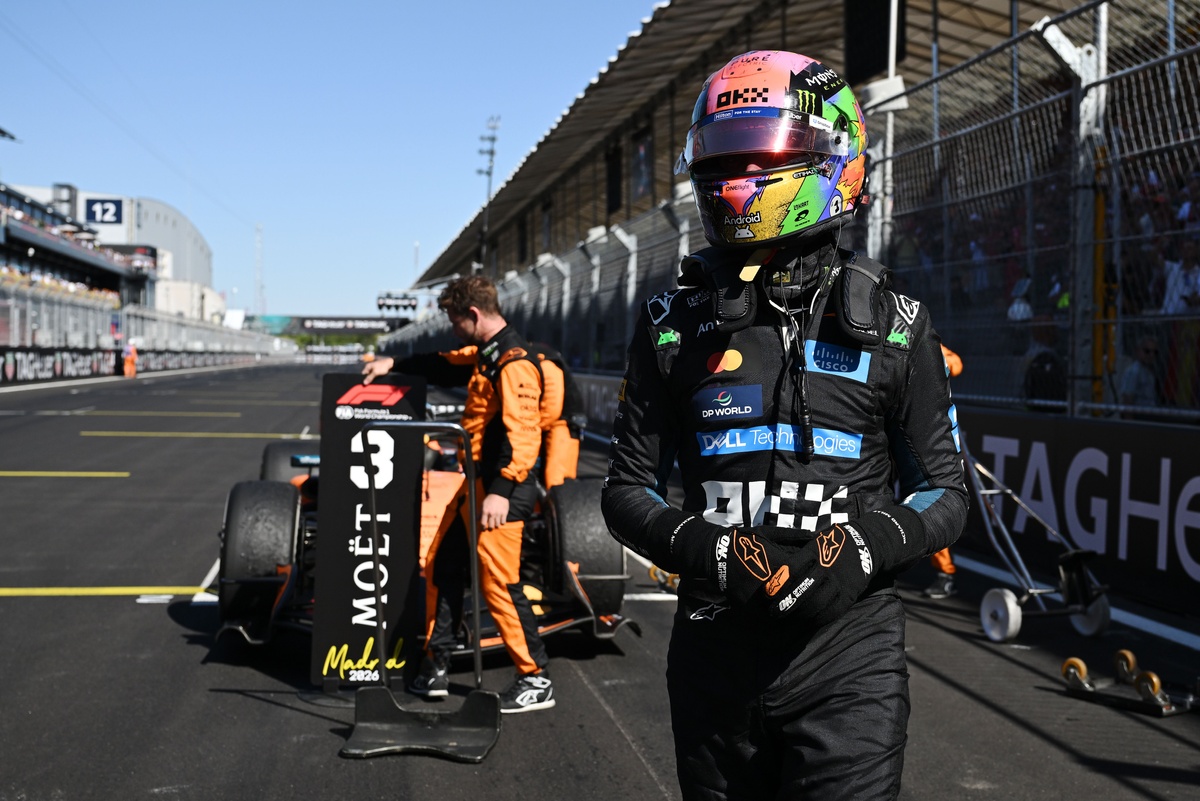
Lando Norris lost a potential Formula 1 victory at the Spanish Grand Prix through no fault of his own or his team’s, but due to the unfortunate timing of a virtual safety car (VSC) deployed on lap 14 following Lance Stroll’s retirement. The McLaren driver missed the pitlane entry by mere seconds before the VSC activation, making him the primary loser in a scenario where his main rivals—who lacked his outright pace—gained a “cheap” pit stop. The fastest driver on track ultimately settled for third place.
Norris Questions Fairness of Current VSC Rules
The outcome reignited debate regarding potential rule changes, with the VSC becoming the dominant talking point in Barcelona. Speaking in the post-race press conference, Norris expressed frustration over the lack of control he had over the situation.
“There’s literally nothing I could do as a driver today to do a better job,” said Norris a few minutes after the finish in the press conference. “Pole, led the race, and to lose it for nothing in my control is, I don’t think, how a race should be won.
“But I think people… I hope people agree, I think people would agree. But it is racing and it’s happened, so I can’t really complain about it. I can be upset about it, but I can’t really complain about it.”
Proposed Solutions: Closing Pitlane or Mandatory VSC Duration
In the aftermath, “easy solutions” often surface. Norris himself outlined two prominent ideas during the same press conference.
“We have spoken about it in the past several times, about how it can be at least covered for one lap or everyone has the opportunity to do the pit stops, or you just block the pit entry and no one can box apart from if you have a puncture or something, you know.
“So, I think there’s a few things you could do to make it more simple and more fair for everyone, but that’s a bigger discussion.”
While both options—closing the pitlane under VSC or ensuring a full-lap VSC duration—would have neutralized the disadvantage for Norris in Spain, analysis suggests both create significant new problems.
Why Closing the Pitlane Creates Safety Risks
Closing the pitlane entry during a VSC would prevent the “cheap stop” scenario. Without refuelling, cars do not risk running dry during a safety period, making this seem logical. However, VSCs and safety cars are primarily deployed for on-track incidents involving damaged cars.
Closing the pitlane while cars are circulating with damage—such as missing wheels or front wing failures—is illogical and unsafe. Allowing only damaged cars to pit introduces regulatory grey areas: defining what constitutes “damage” is complex. For instance, would the front wing damage sustained by Oscar Piastri in Madrid qualify? Furthermore, it could incentivize drivers to deliberately induce punctures to earn a pitstop right.
“I think it’s something, as a group of drivers, I think we would all want,” he said, but also admitted that “there’s a lot more to it”.
“You know, depending on if it’s raining and there’s a VSC and you’re on slicks, does it mean you can box or not? It’s a complicated subject.”
Preventing drivers on slick tyres from switching to wets during a VSC deployed for safety would contradict the very purpose of the intervention. If a simple fix existed, it would likely have been implemented long ago.
Why a Mandatory Full-Lap VSC Fails Strategically
The alternative—guaranteeing the VSC lasts at least one full lap so every driver can pit—addresses the specific Madrid scenario where the VSC ended before Norris completed his lap. However, this creates strategic distortions in other common scenarios.
Consider if Norris had pitted on lap 12 to cover an undercut from Kimi Antonelli (Mercedes). A subsequent VSC on lap 14 would put Norris at risk of losing track position to Antonelli. A mandatory full-lap VSC would guarantee Mercedes a “cheap” stop regardless of how quickly the track was cleared, artificially enforcing an “unfair” outcome. Critics would then likely demand race control act faster, ignoring that safety—not sporting equity—dictates deployment duration.
Safety Remains the Sole Priority for Race Control
The sporting outcome is not a factor for race control when deploying safety measures, nor should it be. Motor racing remains dangerous; safety is the only priority during incident management.
“But I think as a collection of drivers, if we all talk about it, I think everyone wants the same thing, and that’s just fairness for everyone,” said Norris. “So yeah, of course I’m complaining about it today. I could benefit from it next week, next time out, and I could win because of it.
“So yeah, I have to take it on the chin, but I just hope it doesn’t happen to anyone again because it’s just not how you should lose a race.”
Accepting the Inherent Unpredictability of Sport
While drivers are right to raise concerns, media headlines demanding immediate rule changes based on one event should not dictate regulatory overhauls. The Spanish GP highlighted a long-standing issue with VSC timing luck, but its persistence exists precisely because no simple solution withstands scrutiny across all scenarios.
Those offering straightforward fixes typically fall into two categories: those who misunderstand the complexity of the problem, or politicians. Ultimately, the only realistic “solution” may be accepting that sport is not always fair—and that the VSC lottery, while frustrating, is an inherent variable in Formula 1.