Salma Hayek Pinault and Angelina Jolie on Without Blood, Directing, and the Freedom of Being 60
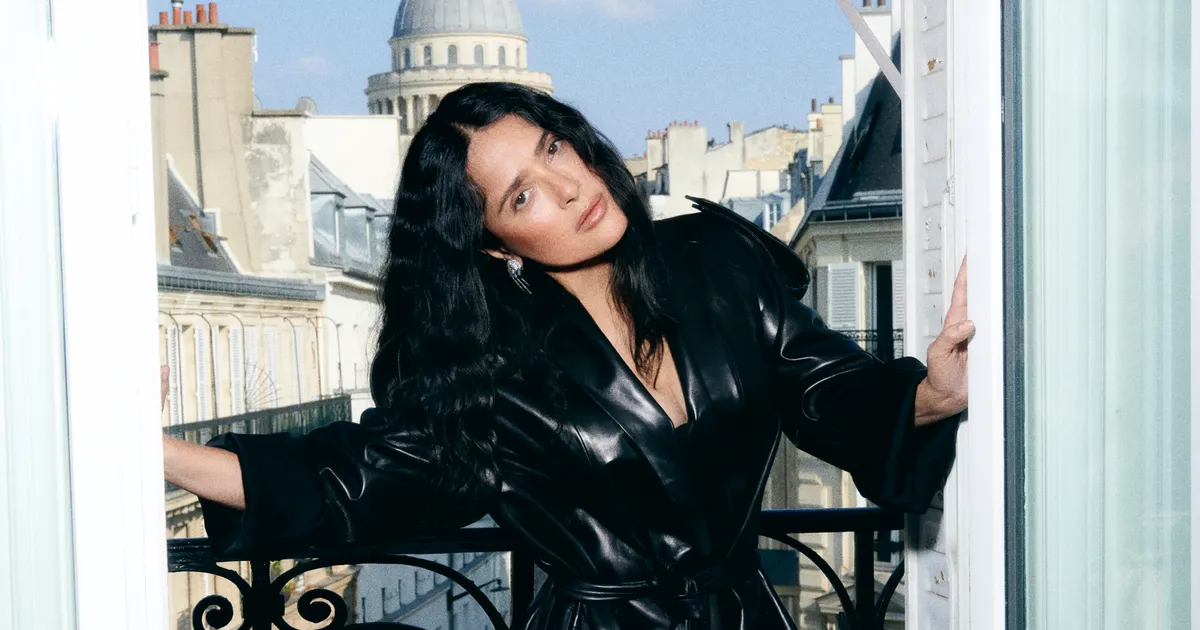
It has been a banner year for Salma Hayek Pinault. She moved to Paris, welcomed a grandson, began editing her forthcoming feature-directorial debut — Arena, which she also wrote and stars in — and celebrated her 60th birthday. The path to this moment began seven years ago at San Diego Comic-Con, where she met Angelina Jolie while promoting Marvel’s Eternals. They became fast friends, and Jolie later cast Hayek Pinault in her adaptation of Without Blood, Alessandro Baricco’s novel set against the backdrop of an unnamed 20th-century war. The film, which receives its U.S. theatrical release in September, stars Hayek Pinault as Nina, a woman who survives an ambush on her home as a young girl and, decades later, meets the man who spared her life for a gripping conversation about guilt and grief. Below, Jolie interviews the Without Blood star about collaborating on one of the most challenging films of her career.
The Weight of Nina: Strength Versus Soul
SALMA HAYEK PINAULT: I was afraid to do this part. I didn’t want to suffer. It demanded me to be at the verge of tears without crying. And this is not a piece where you can fake it. This is not a director you can fool. You’re sharp. ’Cause you have that taste and that eye of the tiger. There was one time when I thought I did the best single take, the best performance of my life. I was like, She’s gonna be so proud of me. She’s gonna flatter me. And you were so serious. You said, “By now, we know you can act, but that was just so predictable and so arrogant.”
ANGELINA JOLIE: I hope I didn’t say that.
SHP: No, about the character.
AJ: The strength took over the soul.
SHP: Yes, the strength and the anger of the character. I had to go again for the higher purpose of the film. You said something that means so much to me it makes me want to cry: “I didn’t cast you for your strength. I cast you for your healing ability. Sit down at that table and heal your enemy to heal yourself. Give him the opportunity. You have to come from that place so everyone who watches can be inspired to go there: I’m not here to win; I am here to heal myself and others.”
AJ: People don’t know you. Your desire, your ability, your nurturing, your feeling, your warmth, your soul — they are the strongest parts of you. And because you have all these other attributes, sometimes that’s not what’s focused on.
SHP: But you know what? I’ve also never felt so seen because usually they would say, especially at the beginning of my career, “I cast you because you’re cute, so stop trying to be smart.” [Laughs.]
Roots, Nature, and a Shared Language
AJ: You’re much more of an academic than people realize. It’s part of your contribution as a creative to help people feel connected to your womanhood, your culture. It was beautiful to be in your homeland with you.
SHP: And in the places where I grew up, in nature. I was so surrounded by nature, and I took it for granted. It’s part of my spirituality. Sometimes we reject it or we don’t find the beauty in it because it’s everywhere. But as you walk away from it, and got wiser and older, I realized how subconsciously it was so important to me and to who I became.
AJ: To see you in your natural state — it is so warm and open and of the earth.
SHP: The funny thing, Angie, is that in the middle of the jungle, where everybody’s so scared and uncomfortable, you and I were in our element. We were the most ourselves that we could be. It was funny because I think my country is very diverse. And you were saying, “This reminds me of Vietnam, and this part of Cambodia…” I could see you light up because all those places are your home.
AJ: Without Blood was challenging for me because almost all my films deal with conflict and war because of what I’ve seen, what I want to study and understand. But it’s often a landscape or a country, like the former Yugoslavia or the Cambodian war. This film was the map of the human and the human face as a country. That did put a lot on all of you because we didn’t leave to shoot action scenes or wides and locations. It was really trusting that the soul and humanity of a person is captivating. But it means the actor has to be so completely honest in every moment because we were right inside you and there was nowhere to hide.
SHP: And you know what? I didn’t want to hide. I don’t think I could have done it with anyone else. I’ve never felt so free in my life as an actress. You gave me everything I ever needed. I was spoiled by the process. My co-star, Demián Bichir, felt the same way. This was also the first time that I was given the choice of the actor I played opposite — the first time I was involved or consulted or asked about it. And I didn’t even ask for it.
AJ: That’s crazy considering your career and your life. Also, it’s not about having the power to be consulted; it’s that when things are so intimate, it’s really important that the actors have at least a say as to why they might connect to someone else.
SHP: Yes. I was able to work with a good friend. I worked with him before in small roles. We couldn’t believe our luck. We pinched ourselves every day, even if the work was about suffering.
AJ: I couldn’t have done it with other actors. This required such a level of dedication. I was glad you knew each other. We shot some scenes in order, and you two kept quite a distance. You didn’t reconnect until the end. That wasn’t me; that was a really intelligent choice you both made.
SHP: Sometimes as an actor, you think, I need to torture myself to do the job better. I felt that because I was so supported, I didn’t need to torture myself for real.
AJ: I did feel at times I was torturing my friend, but I loved the experience.
A Director Who Acts, An Actor Who Directs
SHP: Because you are also an actress, not just a director. At the beginning, I didn’t know how I was gonna hold the emotion for that length of time. I said, “I think I need to cry and then continue because it’s choking me. I’m gonna have a panic attack.” And you go, “Yeah, maybe that’s a good idea.” I would start sobbing on you, hugging you. Sometimes we’d start talking in my trailer about one part of the scene, and then start talking about war. Everyone could hear us screaming or laughing. They must have thought we were crazy. Then I would go back to work. I called you in the middle of the night and said, “What do I do? I can’t get rid of it. I still have the anxiety of her.” You would walk me out of it. I could call you at 2 a.m. if I were in a panic. After the first week, it was easy. But you were always there.
AJ: You should talk about directing. I saw you on the set of Arena, leading and deciding and taking responsibility for it. You embraced it so fully.
SHP: Your film and my film are both conversational pieces. But they could not be more different.
AJ: You’re right. Our films are not trying to dictate how the audience is supposed to feel or interpret but to give questions and feelings and conversation.
SHP: We created a landscape for people to explore themselves. My co-star in Arena says he enjoys me the most when you are on the set. He thinks I seem the most relaxed as an actress and that I am not feeling the pressure of directing. He says, “I can just talk to you in a different way.”
AJ: Well, it’s hard to direct yourself. You would take on something as challenging as that the first time you direct. And write it yourself. But that’s your way. It had to be your vision. You’re good with a challenge. You like a big mountain to climb. [Laughs.]
From Ugly Betty to Proving the Crossover
SHP: When you have a vision, you suspect that everybody thinks you’re crazy. In the aughts, when I produced Ugly Betty, it was important for me to bring it to life because I knew there was a huge audience American television was not tapping into: the Latino American audience. This show was already famous in Latin America. I wanted to show that our stories were 100 percent capable of crossing over. I wanted to prove myself right.
SHP: I convinced the network to do it. And my God did I have to fight. That was not the conventional aesthetic of a leading lady at the time. They rejected me a million times, so I took it to the advertisers with a study of the Latino power of consumption that I had done myself with Pepe because at the time, data was not easy to access. The advertisers wanted to pay for advertising time in the show. And with the commitment of an agency, I went back to the networks and said, “Look, are you sure you want to pass on this? Because they’re willing to pay for the show.” That’s how I got it on the air. Never been done before. The network executives were actually upset.
SHP: We tried to expose the audience to different struggles of the different characters in each episode. Of what it means to be a family of immigrants in Queens. I hope it reminds people to dream — about the professional aspect of your life, the romantic aspect of your life, and family and community.
What Comes Next: Murder Mysteries and Psychological Thrillers
AJ: What are projects or parts of life that you would like to explore?
SHP: Oh my God. Angie, I’m not gonna be that deep right now.
AJ: No, don’t be, then. I mean, I already know that you discovered what it is to be a director, and you’re a great producer. Do you think you’ll be doing more of that?
SHP: You know what I’ve gotten a taste for? Murder mystery. [Laughs.]
AJ: God, you’d be so good at that. Like, a fun one.
SHP: A psychological thriller. I’d love to do that. What about you, Angie? I’m not supposed to be asking the questions. I know what you’re good at and what I’d love to see you in. You’re really funny.
AJ: Aw. [Laughs.]
SHP: We laugh a lot. You have a wicked, dry sense of humor. You can be very clever and hilarious. But always in an elegant way. That’s what I would like to see you do. I also want to make sure I strengthen my community. I’m quite excited about my 60s, though.
AJ: I’m excited for you.
SHP: I feel young. I’m sorry — no, no, no, I’m not gonna apologize. It is good for me to be at this age. I am at my best today. The funny contradiction is that, as women, as we get older, we have more things to say and we can say them more clearly. Yet we have less opportunities to say them. Makes no sense.
AJ: We have to, as artists, evolve, and you contribute something different when you’re older than when you’re younger. When we think about our children, so much of that is also exploring womanhood and seeing what challenges we faced.
SHP: Let’s go back to the young ones. [Laughs.]
Motherhood, Privacy, and Staying “Cool”
AJ: They have their unique thing to say, right? At every stage. Also, they’re communicating with each other. Young people can relate to each other in different ways, and they’re facing a new world. We were both raised at that time when there was more privacy and you could get lost in the world. There was more community because there was less technology. Different dangers, but a lot more freedom. Less outside influence, in a way. It was easier to shape yourself more independently.
SHP: We have been able to create good communication with our kids because we try to stay in touch with these new generations. What are they into? What do they like? We learn from them. I learned from your children. For all the things we wonder if we did right or not, I think we stayed cool. Cool moms. Not too cool, though.
AJ: You’re the mother, but you’re their friend as well. I value that too. You need to find that line because you’re the parent, but you don’t know everything, and you are also there to step back. There is a lot they can share and teach us. That builds friendship. You realize how smart your own children are. You want them to have other great people in their life to teach them what you don’t know.
SHP: They feel very safe telling you anything, calling you for advice or little things. But they have the right to their privacy too. They are so different, and you adjust to each one of them beautifully. You let them be themselves. I see a lot of mothers try to design their kids, and it puts so much pressure on them. I don’t think we’re that type at all.
AJ: No. I’m more comfortable with somebody who’s just who they are. I get uncomfortable when someone puts a false face forward; it makes me uneasy.
SHP: You’re allergic to fake. That’s for sure. “You can insult her if you want. But don’t do fake because she’ll walk away.” This is my favorite Angie-ism: You tell me not to do something, or you give me good advice to do it a different way. I become stubborn about it. And then you go, very lovingly, “I am going to support you because I know you’re gonna do it anyway. I can see why you’re doing it. So just try to protect yourself.” And I go, “No, no, I know what I’m doing.” Then I go, God, I should have listened to Angie. [Laughs.] I call you and I tell you. You don’t say, “I told you so.” You say, “Yeah, we knew this was gonna happen, but at least…” You bring me back to my original intention that got me into trouble, which was an honorable intention. You know what I’m talking about?
AJ: You always have good intentions. And you appreciate a hard truth, as do I. It’s a way of caring for me if somebody pulls me aside and tells me where I’m off or challenges me.
SHP: I’m excited to learn how to be there for my kids in this new era of their life, which means I have to relearn everything again.
AJ: Yeah. It’s complicated.
SHP: I’m excited about the people and animals in my life.
AJ: You and your animals. I’ve been in the room with your owl.
SHP: That’s true! She’s gone, my owl. I’m excited to continue to evolve in my wonderful relationship with my husband and to continue to discover each other. I am loving my life in Paris right now. I am in a new house, and my oldest daughter comes by every day. I’m enjoying her as an adult living in the same city. She has her own apartment. I was coming to Paris a lot but more on the weekends. Now I’m full time in Paris only. It’s just a whole new life for me. The kids are out of the house; I’m an empty nester. I almost convinced you to move to Paris for a minute. You considered. I’m like, “Come on, girl, you can’t leave me alone there.” You want somewhere more wild.
AJ: We’ve had some fun. I needed to have some fun. You met me in a dark time in my life, and you’ve made me smile.