Madrid’s Grand Prix History: From Jarama to the Madring Debut
The 2026 Formula 1 season arrives at the Spanish Grand Prix this weekend, marking the highly anticipated debut of the Madring circuit. While this is the first time F1 has raced at the new Madrid venue, the Spanish capital boasts a rich history with the sport, having hosted the Spanish Grand Prix for the first time in 1968 at the Jarama circuit.
Located approximately 30 kilometers north of the city center — significantly further out than the new Madring location — Jarama was introduced to the calendar in a shared rotation with Barcelona’s Montjuic Circuit. This arrangement was part of a concerted national effort to establish Spain as a fixture on the international motorsport stage.
A tragic accident at Montjuic led to Madrid becoming the permanent host of the Spanish Grand Prix between 1976 and 1979, and once again in 1981. Those races produced victories for legends such as James Hunt and Mario Andretti. However, the event disappeared from the calendar for several years due to waning interest and challenging weather conditions. By the time the Spanish Grand Prix returned, Jerez and Barcelona had been selected as the preferred venues.
Madring Circuit Layout: What Drivers Can Expect
The short answer regarding the driving experience is that none of the competitors will know for certain until Free Practice 1 begins on Friday, September 11. However, the circuit layout and a useful test completed by Formula 3 provide valuable early indications.
The lap begins with a short run of roughly 200 meters down to Turn 1, before a right-hander launches drivers toward the third corner and onto the longest straight on the circuit. Speeds climb rapidly until a heavy braking zone arrives, accompanied by an elevation change and a blind apex at Turn 8.
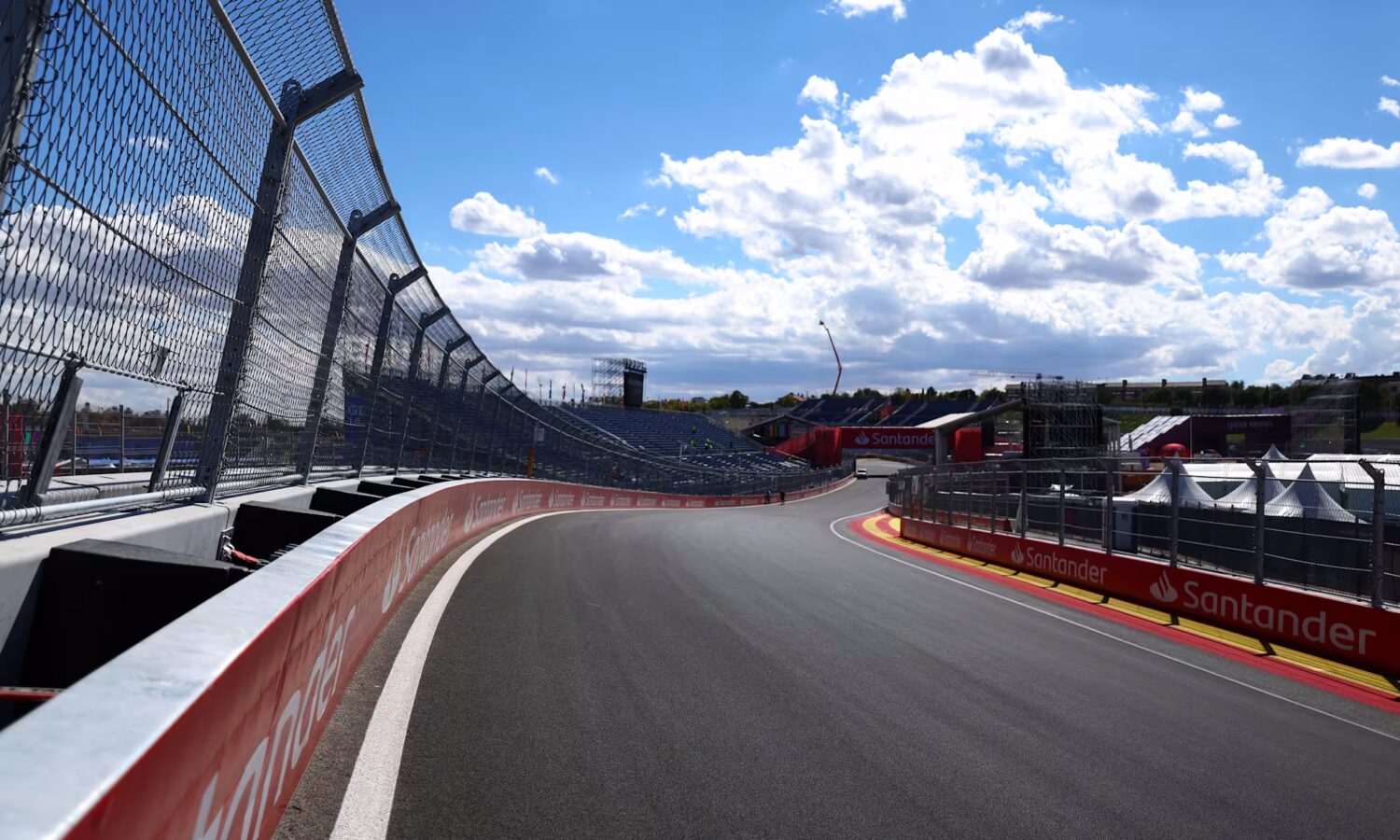
The street section concludes at this point, transitioning to the permanent track facility. A chicane sets up La Monumental — an ambitious and exhilarating banked curve featuring a 24% gradient. Thousands of spectators will line this section, where multiple racing lines are designed to encourage a variety of overtaking maneuvers.
Another flat-out sequence of corners follows, but precision becomes paramount as the walls close in. The track then enters a twisty, technical complex culminating in a tight final corner that leads back onto the start/finish straight.
Straight Mode Zones at the Madring
As a reminder from the pre-season regulation summary, Straight Mode is a distinct aerodynamic configuration that allows cars to reduce drag, improving efficiency during high-speed acceleration.
The rear wing opens a gap — similar to the former Drag Reduction System (DRS) — but now the front wing moves in synchronization. The uppermost front wing elements drop down simultaneously with the rear wing’s top element. This mode is deployed on every lap in dry conditions within designated areas, allowing the car to switch between two configurations: maximum downforce in corners and minimal drag on straights.
At the Madring, there are two designated Straight Mode zones:
- A run along the start/finish straight.
- The section between Turns 3 and 4.
Overtake Mode Detection and Activation Points
Overtake Mode replaces DRS as a new power deployment strategy. It enables a driver to recover more electrical energy and access an additional electrical power profile, sustaining higher speeds for a longer duration.
There is a single detection point per lap for this mode — typically positioned after the final corner leading onto a long straight. It becomes available on the following lap provided the driver remains within one second of the car ahead at that detection point.
For the Madring, the Overtake Detection marker is situated just before the entry to Turn 22. The Overtake Activation line follows on the exit of that corner, heading onto the start/finish straight.