
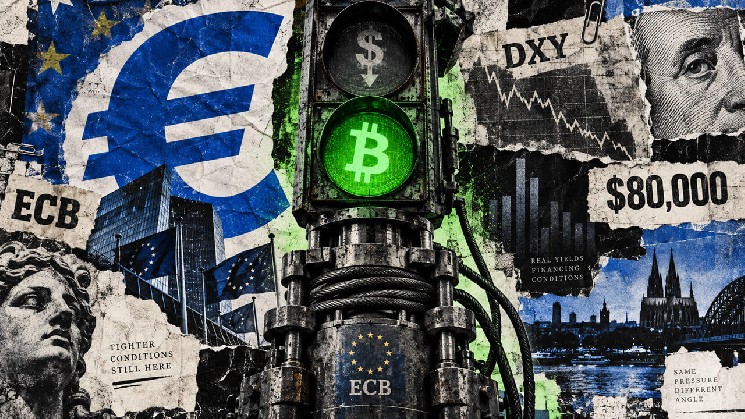
Bitcoin’s Next Macro Catalyst: ECB Decision Could Weaken Dollar Without Easing Financing Conditions
The European Central Bank’s September 10 policy decision may strengthen the euro and push the U.S. dollar index lower, offering potential relief to Bitcoin after its recent slide below $80,000. However, a currency-driven decline in the dollar index would provide limited evidence that the financing conditions restraining risk assets have actually improved.
Data from CryptoSlate showed Bitcoin trading around $78,800, down roughly 1% over 24 hours, after stronger U.S. labor data revived expectations that interest rates could remain elevated. That leaves Thursday’s ECB decision as the next major macro event capable of shifting the currency backdrop before U.S. inflation data returns focus to the Federal Reserve.
Euro’s Heavy Weight in Dollar Index Creates Potential False Positive for Bitcoin
The distinction will hinge on what moves alongside the euro. A sustained Bitcoin recovery would carry more weight if it coincides with lower real yields, easier credit conditions, and gains in both BTC/USD and BTC/EUR pairs. A falling dollar index on its own could simply reflect Europe becoming relatively more attractive.
The complication stems from how the dollar index is constructed. The euro carries a 57.6% weight in the Intercontinental Exchange’s dollar index, far larger than the Japanese yen at 13.6% or the British pound at 11.9%. A sufficiently strong move in EUR/USD can therefore drag the index lower even if U.S. borrowing costs remain high and the amount of capital available to investors barely changes.
That creates a potential false positive for Bitcoin traders who use the dollar index as a shorthand for liquidity conditions. If the euro appreciates while Bitcoin’s dollar price remains unchanged, the cryptocurrency becomes cheaper for a euro-based buyer. If Bitcoin subsequently rises in dollars but makes little progress in euros, part of the apparent strength can be explained by currency translation rather than broader demand.
Recent Bitcoin Price Action Shows Mixed Signals Across Currency Pairs
Recent trading illustrates why the distinction can be useful. Between the September 1 and September 3 UTC closes, Bitcoin gained 4.99% against the dollar and 4.63% against the euro. That advance occurred alongside a modest decline in U.S. real yields, giving the move support beyond foreign exchange.
The pattern reversed later. From September 6 to September 7, Bitcoin fell 1.55% against the dollar and 1.65% against the euro, showing that the weakness was visible to holders on both sides of the Atlantic rather than being driven primarily by a change in the dollar-euro exchange rate.
Thursday could produce a less straightforward configuration if the ECB sends the euro higher while bond yields and credit conditions remain restrictive.
Euro-Area Growth and Inflation Data Offer Competing Signals for ECB
That risk has increased because the economic backdrop facing ECB officials gives markets reasons to pull the euro in either direction without a clear shift in monetary conditions. Eurostat this week revised second-quarter euro-area growth to 0.6% from the previous quarter, strengthening the headline picture entering the meeting. Yet the composition was heavily skewed toward trade.
Net exports contributed 0.9 percentage points to quarterly growth, while inventory changes subtracted 0.5 points. Household consumption contributed 0.2 points and fixed investment made essentially no contribution. The figures suggest a stronger aggregate economy without the same acceleration in domestic demand that would typically point to a broad improvement in financing conditions.
Inflation is sending a similarly divided signal. Headline euro-area inflation accelerated to 3.3% in August from 2.9% in July, largely as energy inflation jumped to 14.3%. Meanwhile, inflation excluding energy, food, alcohol and tobacco eased to 2.4% from 2.5%, while services inflation slowed to 3% from 3.3%.
That combination leaves policymakers balancing a renewed headline inflation problem against signs that some underlying pressures are cooling.
Credit Conditions Continue to Tighten Despite Potential Euro Strength
The ECB’s July meeting account also showed that financing conditions were already moving in the opposite direction from the relief Bitcoin bulls would prefer. Credit standards for business loans tightened somewhat in the second quarter, while mortgage standards also became stricter as banks grew more concerned about economic risks.
The ECB said financial conditions had tightened slightly since June, with higher longer-term yields beginning to feed into borrowing costs. Business lending rates stood at 3.6% in May and market-based debt financing costs at 4%. A stronger euro after Thursday’s decision could therefore coexist with expensive credit.
US Inflation Data Will Quickly Reclaim Focus After ECB Decision
For Bitcoin, the trade becomes clearer only if the ECB reaction spreads beyond currencies into the markets that determine the cost and availability of capital. A euro rally that pushes the dollar index lower while real yields stay elevated would leave leveraged investors facing much the same funding environment as before the decision. Bitcoin could still rise, but the move would carry less evidence that a broader liquidity shift was underway.
The sequencing also gives traders little time to settle on the ECB interpretation. U.S. producer-price data are due Thursday, the same day as the ECB decision, followed by August consumer-price inflation on September 11. The CPI release will return attention directly to the Federal Reserve after July consumer inflation ran at 3.4% from a year earlier.
That leaves any ECB-driven Bitcoin rally vulnerable to being repriced within 24 hours. If the euro rises, the dollar index falls, and Bitcoin climbs in both dollar and euro terms while real yields retreat, investors would have a broader set of signals supporting renewed exposure. If U.S. inflation instead drives yields higher on Friday, traders could find that Thursday’s apparent dollar relief lasted only until Washington reopened the argument over how expensive money will remain.