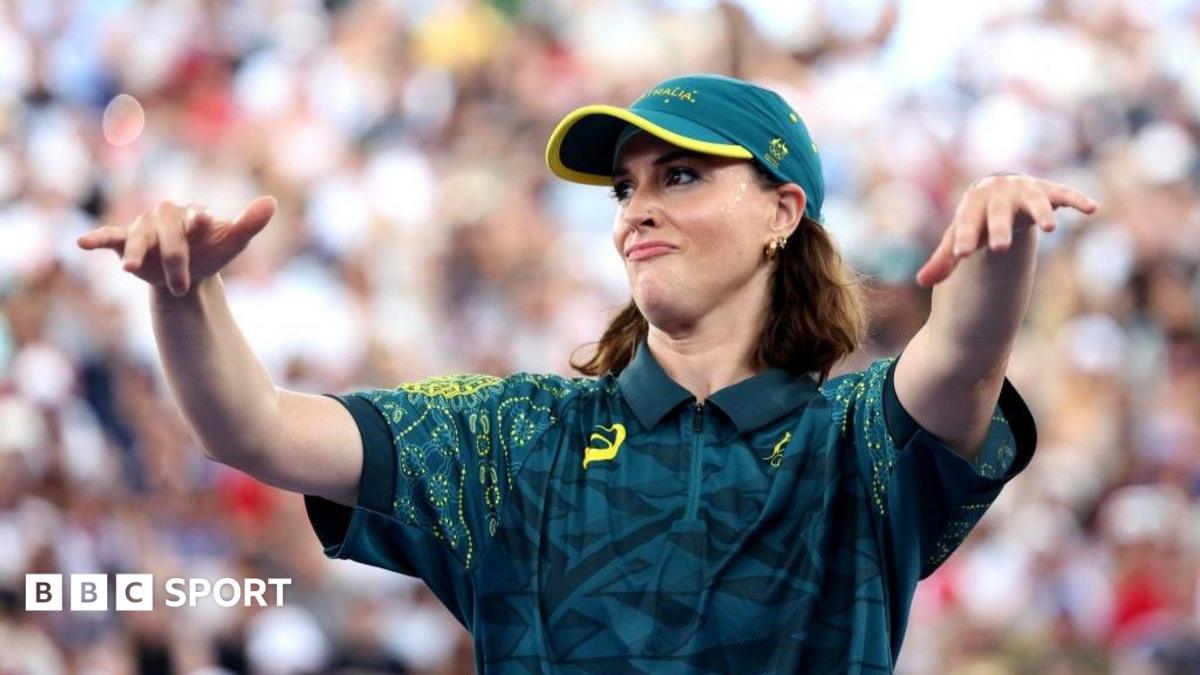
Rachael Gunn suffered a panic attack in the Olympic village just hours before representing Australia at the Paris 2024 opening ceremony.
Surrounded by experienced athletes, Gunn began to understand the scale of the challenge ahead. Her professional background was as a university lecturer, but she was about to compete in breaking, the breakdancing event making its Olympic debut.
Known as Raygun when competing, the 38-year-old described her anxiety in a new Netflix documentary about her experience at the Games.
“I felt like an imposter,” said the 38-year-old breaker.
She also explained how she reacted after seeing someone she recognised from the Olympic team.
“I just could not stop crying… I had a panic attack. ‘What am I doing? What have I done? Should I be doing this?'” she said.
Just a few hours later, Gunn was sailing down the River Seine alongside the rest of the Australian delegation, waving to onlookers.
Raygun’s Olympic breaking performance goes viral
Less than a fortnight later, her Olympic journey was over. Gunn lost all three of her round-robin battles at the Games, but said she was pleased with how she had performed.
“Finishing my last round, the world champion Nicka [Dominika Banevic] gave me props for my moves, the MC celebrated my stuff and the vibe was just generally good,” Gunn told BBC Sport.
What she had not expected was the global reaction to one of her routines, in which she introduced unconventional moves including a sprinkler and a kangaroo hop.
The performance quickly became a viral sensation. It inspired memes and a sketch on The Tonight Show Starring Jimmy Fallon. Adele referenced it during one of her concerts, while Chris Hemsworth defended Gunn in an interview with Jimmy Kimmel. In August 2024, Australian Prime Minister Anthony Albanese also spoke out, praising Gunn for having “a crack”.
“It was pretty wild the way I became a topic of conversation in spaces I never thought I would be,” said Gunn.
Conspiracy theories affected Rachael Gunn’s mental health
Alongside the teasing, Gunn faced more serious online attacks, including conspiracy theories alleging nepotism. One claim suggested that her husband and trainer, Samuel Free, had been on the selection committee when she qualified to represent Australia at the Games. He had not been.
“It was really tough when mine and Sammy’s credibility, ethics and motivations were being called into question,” Gunn said.
“You could just spend 30 seconds researching and find plenty of sources to debunk these conspiracies, but that’s not how people use the internet anymore.”
The intense scrutiny took a toll on Gunn’s mental health.
“I felt like my whole life was just kind of crumbling before me.. .and I was just trying to get through the day,” she says in the documentary.
While making a film about that period, Gunn said she had begun to regain a sense of control over her story.
“It’s taken a long time for me to process what happened,” Gunn told BBC Sport.
“It’s really exciting for me to finally have a voice again.”