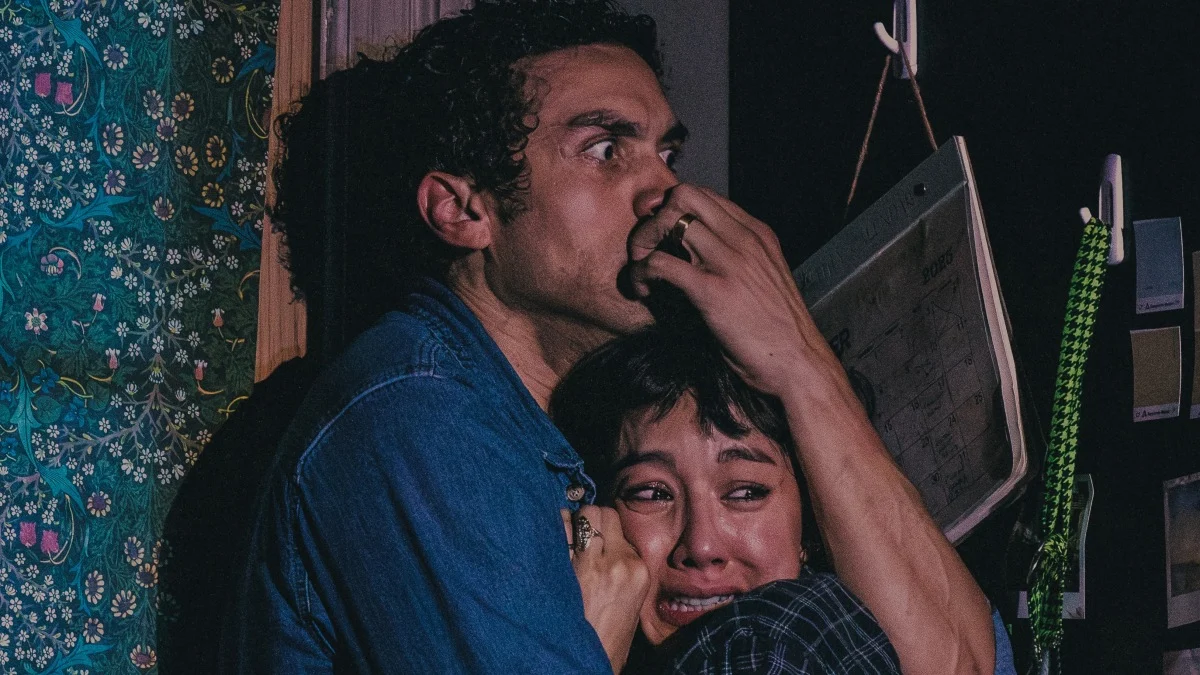
Broadway’s latest horror offering, Paranormal Activity, arrives with a familiar promise: turn a recognizable piece of intellectual property into a theatrical event. But unlike productions such as Cats: The Jellicle Ball, which transformed Andrew Lloyd Webber’s musical into an immersive ballroom experience, this adaptation relies primarily on jump scares—and struggles to deliver the spectacle Broadway demands.
Cats: The Jellicle Ball earned critical praise, enthusiastic audience reactions and three Tony Awards, including Best Direction of a Musical, yet closed only weeks after receiving those honors. Its fate reflects Broadway’s current dependence on adaptations of movies, television shows and other popular properties. This year’s crowded field has included The Lost Boys: A New Musical, Titanique, Schmigadoon and Dog Day Afternoon, while Heated Rivalry received an unofficial off-Broadway parody before its vinyl soundtrack release. Some adaptations have been excellent or intriguing. Beaches was not.
Paranormal Activity brings a thin new story to Broadway
Now Paranormal Activity has joined the lineup. The production premiered in Leeds before its 2025 West End debut and earned praise on its journey to Broadway, including during a sold-out Los Angeles run. That momentum created considerable anticipation for its arrival at the August Wilson Theatre.
Unfortunately, the Broadway production is not a particularly satisfying night at the theater. It offers a string of jump scares without the atmosphere, invention or visual scale expected from a major Broadway production. Fans of the film franchise may be especially disappointed.
Although the Playbill identifies Oren Peli’s 2007 film of the same name as an inspiration, the connection between the stage production and its source material is extremely slight. Written by Levi Holloway, the play follows an American married couple who move from Chicago to London for a fresh start. The choice of London is never explained, and because the action takes place almost entirely inside a small house, the story could have been set almost anywhere.
The location does give James (Travis A. Knight) and Lou (Cher Álvarez) a sense of isolation. New to the city and without a local support network, the ruthlessly rational James and his increasingly distressed wife confront a series of paranormal disturbances.
Like Katie in the first Paranormal Activity film, Lou is troubled by a dark event in her past and fears an entity stalking her. James occupies the role of the skeptical partner, similar to Micah: he claims to want to help while dismissing the supernatural and provoking the possible creature. At one point, he declares, “Fuck the bogeyman.” A jump scare follows almost immediately.
Holloway’s play abandons the franchise’s established mythology, including the found-footage format, and changes the nature of the entity at its center. None of those choices is inherently flawed. Together, however, they raise an obvious question: why is this production called Paranormal Activity when it has so little connection to the existing intellectual property?
A Broadway horror show without enough atmosphere
Paranormal Activity compares poorly with Broadway’s other recent horror productions. The Lost Boys carefully selected the campiest elements of Joel Schumacher’s vampire cult classic, then built a stronger emotional story around them, embraced the film’s queer subtext and recreated cinematic moments through thrilling stage stunts.
It also lacks the comic energy of the recently closed Death Becomes Her, which transformed murderous mayhem into memorable stage gags that sent audiences laughing down the metaphorical staircase alongside Madeline Ashton.
A more direct comparison is Grey House, also written by Holloway. That 2023 Broadway play was another horror story set in a modest home, where an unsuspecting married couple encountered strange children and an unsettling older woman. Grey House built dread through cryptic conversations and a mounting sense that the visitors had made a terrible mistake. Even years later, the precise scares may be difficult to recall, but the experience of screaming remained unforgettable.
Paranormal Activity produced some screams, but not many. For every jump scare that succeeded, several others failed to provoke even a flinch. Audience laughter filled the theater, perhaps as a nervous response or because of the couple’s caustic exchanges. The overall effect felt less like a shared surrender to a horror story than a theme-park attraction designed to provide occasional shocks.
Director Felix Barrett employs familiar haunted-house devices: flickering lights, a shadowy figure crossing the stage, a possible nursery door slamming shut and repeated bursts of deafening sound. After the first few scares, though, the pattern becomes predictable.
Between the grim jokes, the play presents a toxic relationship that is more relentlessly one-note than compelling. Knight and Álvarez bring intensity to their arguments over advice from a ghost-hunting podcaster, played by Eva Kaminsky, and to their attempts to conceal the haunting from James’s inquisitive mother, played by Shannon Cochran, who remains only a video call away.
The drama becomes even less effective when the entity is revealed to be capable of mimicking other people. Vulnerable conversations are consequently undermined by the possibility that they are merely a cruel trick rather than genuine breakthroughs between two people unable to speak honestly. A similar exploration of doubles and fear of intimacy appeared in Leviticus earlier this year—a production that is both frightening and thematically substantial.
Paranormal Activity offers little comparable depth. Its supernatural device makes the already thinly drawn characters feel even less developed, leaving the Broadway production dependent on its central gimmick.
Immersive staging that never becomes immersive
The new story does not require audiences to remember Katie, Micah or their demon Tobi. That could have allowed Holloway and Barrett to create fresh possibilities for horror theater. Instead, the play feels like a murky echo of Grey House: a similar house, a similar setup and considerably less effective scares.
Barrett, a founder of the immersive British theater company Punchdrunk, known for Sleep No More, never fully makes the audience feel trapped inside the haunted home. Unlike Titanique, which expands its stage into the auditorium, or The Jellicle Ball, which sends performers into the aisles and mezzanine, Paranormal Activity maintains a firm separation between the stage and the audience.
The house is designed like a dollhouse, with one wall removed to expose the interior. That configuration can obstruct views for audience members near the front or at the sides, where solid interior walls block parts of the action. More frustratingly, the production does not use the space with enough precision.
In The Lost Boys, director and co-lighting designer Michael Arden used spotlights and other lighting effects to direct the audience’s attention toward one frightening image while preparing another in the shadows. The technique resembled a video game, giving viewers a clear visual cue about where to look.
Paranormal Activity offers no such guidance. For long stretches, the audience must scan the dimly lit house, searching for something frightening without knowing which detail matters. Should viewers follow James upstairs as he uses the bathroom, watch a flickering light or track Lou as she approaches the back door?
In horror, a wide shot can be terrifying because it invites the audience to study apparent stillness and darkness for a threat that the character has not noticed. Here, that searching too often leads nowhere. At times, viewers may even be watching the wrong area, left confused when someone across the theater reacts to a scare they missed.
Paranormal Activity is less frightening than a great horror film and less impressive than a great Broadway production. It appears designed for audiences seeking a relatively upscale alternative to a haunted hayride during the Halloween season, or a spooky children’s option alongside Radio City’s Christmas show.
But with its thin story and underwhelming stage spectacle, the production represents a troubling direction for Broadway: shallowly adapted intellectual property occupying space that could instead support something more daring and genuinely chilling.
Paranormal Activity is playing at New York City’s August Wilson Theatre through Jan. 3.
Source: mashable.com