When Toto Wolff met with the Dutch press at Zandvoort a year ago, Kimi Antonelli was enduring the difficult stretch that defined much of his European Formula 1 rookie season. The young Italian had shown flashes of brilliance in Miami and Canada, but those performances were followed by several challenging race weekends.
At the time, Wolff described Antonelli’s first season in straightforward terms:
“Sometimes there are brilliant moments that leave our mouths open, and sometimes we are pulling our hair out. But that is all in line with expectations.”
Many paddock observers expected Antonelli’s 2026 campaign to follow a similar pattern. Instead, the Mercedes driver has combined his natural speed with a major improvement in consistency.
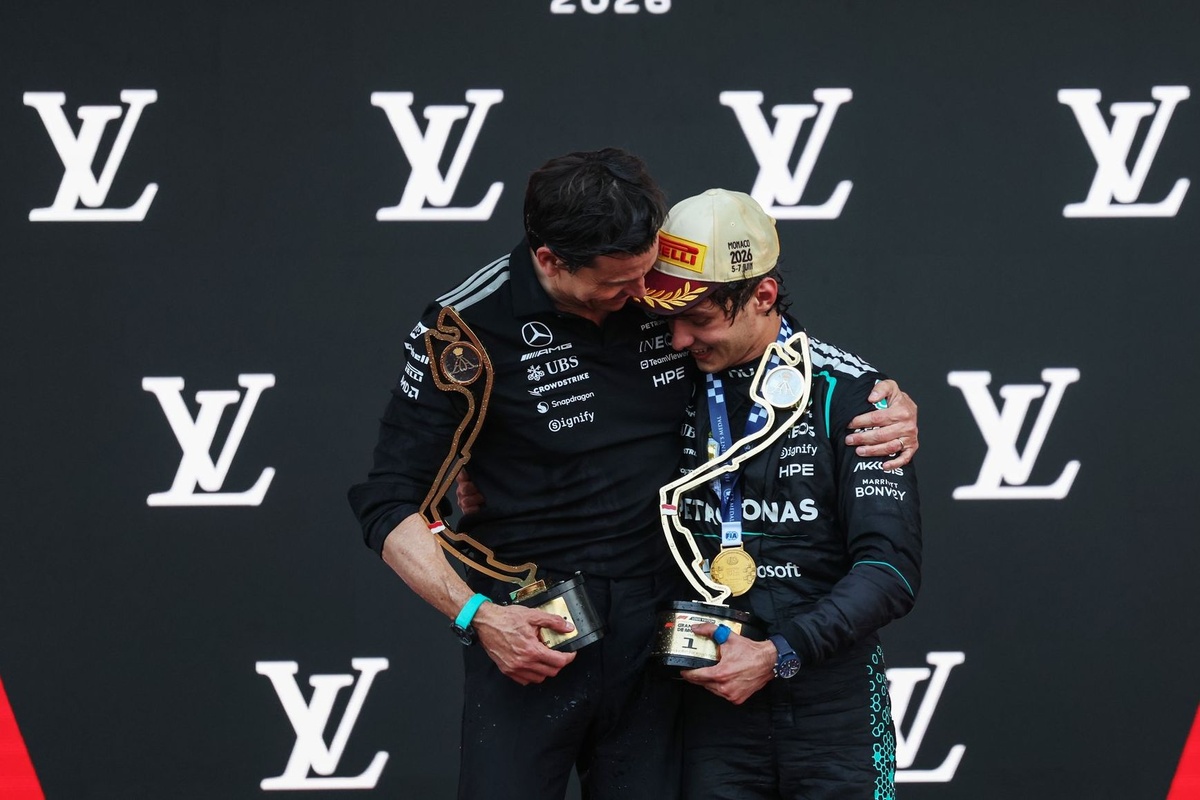
Antonelli has finished on the podium at every grand prix so far except Barcelona and Silverstone. He also leads the Formula 1 championship by 59 points over Mercedes team-mate George Russell and Ferrari’s Lewis Hamilton.
Asked by Motorsport.com whether Antonelli’s progress ranked among the biggest surprises of his long career, Wolff gave a clear answer.
“Definitely,” he said.
However, Wolff said Hamilton and Max Verstappen had already warned him last year that Antonelli possessed the potential to make such a breakthrough.
“I think the great ones, they know,” Wolff explained. “You say it needs one to know one. And I think that when you listen to Lewis or to Max last year, they already said that he has the potential.
“And that’s what we felt in the team too, looking at his previous records in karting and the junior formulas.
“Nevertheless, to come out after the winter and just nailing it pretty much every single race is one of the big surprises in my professional racing career.”
From ‘parachuted into F1’ to no longer being a ‘deer in the headlights’
Wolff believes Antonelli’s rapid development is the result of more than technical factors. Although the 2026 car may suit his driving style better than the previous ground-effect machinery, Wolff also pointed to the driver’s personal development and ability to process information.
“When I analyse it and ask myself what are the reasons that he had such a good reputation in the junior formulas and karting, I think it’s his processing power.
“I think he just needed the winter to process it. Why was it good? Why was it bad? What do I need to do?”
Wolff also credited the greater stability within Mercedes. Antonelli entered the new season in a familiar environment, with less uncertainty surrounding the travel, accommodation, team procedures and circuits.
“And then to come into an environment that he already knew. He knew that flying to Melbourne would look that way. He knew the hotel. He knew the set-up. He comes to the track, and everything is as last year.
“And that means that it just comes down to driving and preparation, rather than being a deer in front of the headlights, like in 2025, thinking what’s happening? But yeah, it’s still one of the very nice surprises.”
The same factors help explain Antonelli’s inconsistent 2025 rookie season, Wolff said. The combination of established technical regulations, limited experience and intense external pressure created a difficult introduction to Formula 1.
“What happened to Kimi last year is just what we predicted,” Wolff added.
“You’re being parachuted into Formula 1. He was 18 under a set of regulations that was very mature. Most of the drivers were racing those cars for a long time and Kimi didn’t know some of the circuits.
“And then there was this avalanche of media requests and pressure. Suddenly everyone who was part of your journey felt they needed to be with you or close to you. The demands were enormous.”
The 54-year-old Austrian said he faced widespread criticism for placing Antonelli in a Mercedes seat so early in his career. Wolff compared the decision with Helmut Marko’s choice to give Max Verstappen an early Formula 1 opportunity at Red Bull, saying both men had seen enough talent to justify taking the risk.
“Everyone and their dog said to me that it was too early, that I shouldn’t have put him into Mercedes and that I should have done a smaller team.
“Spa was probably one of the worst moments, but for me, I stood strong with him because I felt that it was exactly the year we needed,” Wolff said.
“We’re only making the assessment after the second year. And the way he’s come out of the blocks this year is a surprise to everyone, and yes, to me as well.”
Beyond Antonelli’s speed and performance on track, Wolff said the driver’s enthusiasm is now having a positive effect across the Mercedes team.
“He is authentic, very open-minded, not political at all. He completely lacks that negative kind of thing. For him, it’s just all about performance on the track.
“And he’s made all the English mechanics hug each other now, which is also new for us!”