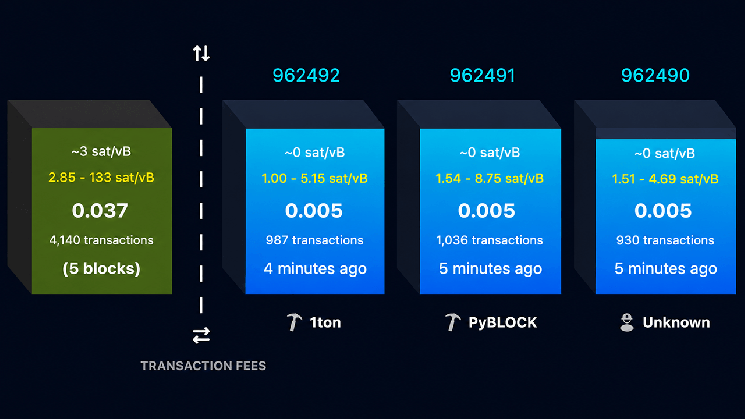
Twenty-three days after the BIP-110 minority chain split from Bitcoin, the alternative network has resumed producing blocks under a new Blake2b proof-of-work system.
The split occurred at block height 961632 after a group of supporters argued that the Bitcoin blockchain should be used only for financial transactions. The minority chain initially stalled because miners struggled to find blocks while operating with the difficulty inherited from the main Bitcoin network.
BIP-110 supporters mined blocks through height 961639. At block 961640, however, the chain accelerated under new Blake2b consensus rules. The block was mined by a pool or entity known as Silent Wave. Luke Dashjr continues to describe the effort as a rehearsal, while the next software release is reportedly expected on Sept. 1. Blockchain data showed that more than 800 minority-chain blocks had been mined since the change at the time of writing.
Dashjr gets the 300 kB block size he wanted
Alongside the proof-of-work change, Dashjr and other minority-chain developers reduced the block size to 300 kB. Dashjr has advocated a smaller Bitcoin block size for years. Bitcoin.com News reported on his proposal in 2019, after the idea was first introduced in a 2017 Bitcoin Improvement Proposal.
While much of the Bitcoin block-size debate focused on whether the 1 MB limit was too small, Dashjr consistently argued that it should be reduced further. His 2019 proposal, like BIP-110, failed to gain significant adoption.
According to the newly launched btc-blake2b.org website and its FAQ page, the Blake2b chain now uses the 300 kB limit. “While those limits are on, a block may also be no larger than about 300 kB (800,000 weight units),” the FAQ page explains.
The minority chain’s block-size change was predicted two weeks earlier on X. The BIP-110 chain has also faced mockery on the platform, where $BTC supporters have said they cannot take the “sh**coin” seriously.
BIP-110 fork lacks support from major crypto exchanges
The forked cryptocurrency associated with the BIP-110 minority chain is not listed on any centralized exchange. Major market-data platforms, including CoinGecko and CoinMarketCap, do not display a ticker for the asset.
Despite the absence of centralized exchange support, the project’s leading supporters have downplayed the issue.
“Let’s not use centralized KYC exchanges for the Blake chain, let’s just earn bitcoin by selling goods and services, and buy goods and services to spend our bitcoin,” BIP-110 developer Chris Guida wrote on X. “Screw fiat,” he added.
Bitcoin community rejects Blake2b fork
Bitcoin supporters have continued to reject the claim that the Blake2b chain is Bitcoin. Following the relaunch, Bitcoin historian Pete Rizzo wrote: “Just In: The failed BIP 110 fork has officially relaunched and removed Bitcoin’s proof of work algorithm; it is now its own incompatible blockchain with its own cryptocurrency,”
Guida rejected that characterization, responding: “Nah, the Blake chain is Bitcoin. Sha256 was never a defining feature of Bitcoin.”
The minority chain is now producing blocks, but the broader Bitcoin community generally treats the split as settled and identifies Bitcoin-Blake2b as a separate fork rather than Bitcoin itself. Whether the bitcoin-blake2b asset develops meaningful market value remains uncertain. For now, it has no major centralized exchange listings and limited support across the wider cryptocurrency market.