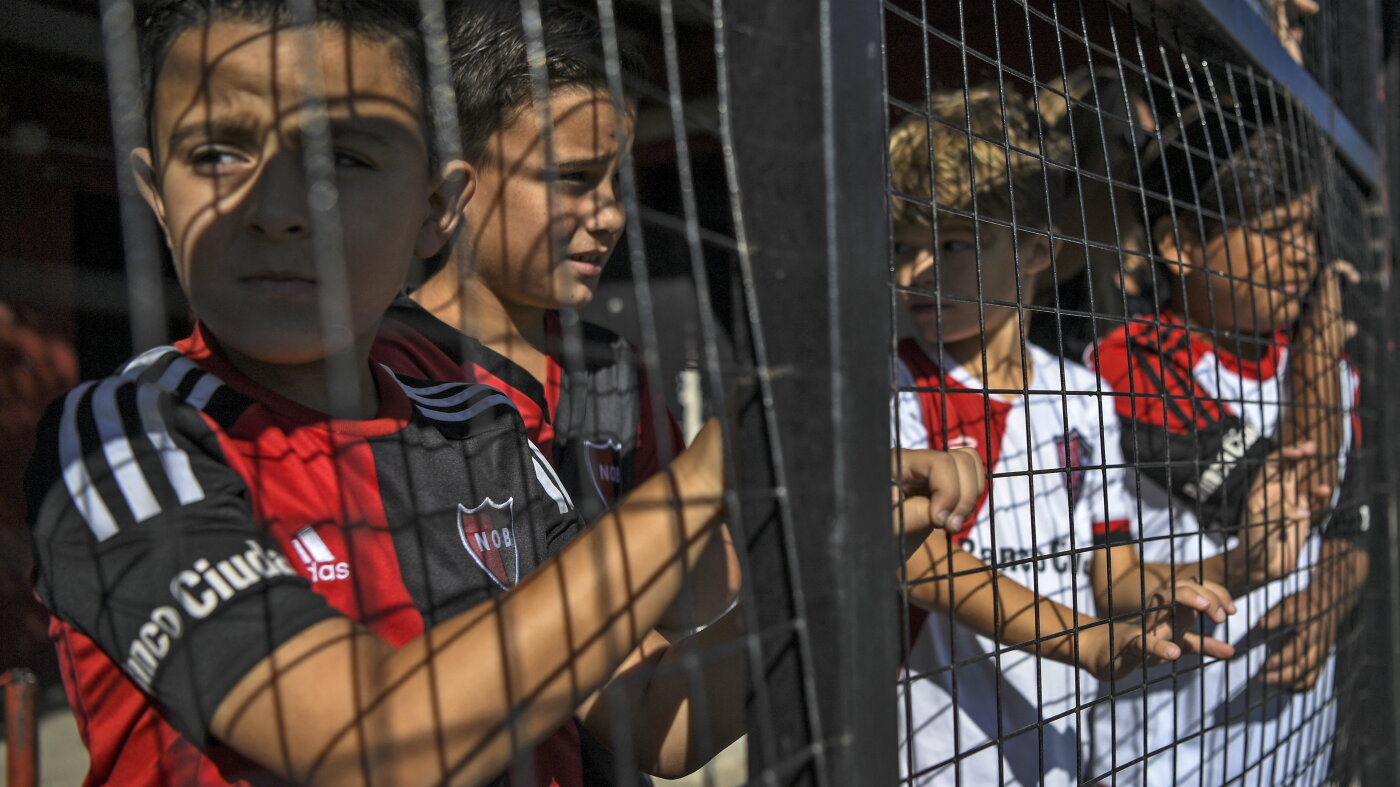
ROSARIO, Argentina — Newell’s Old Boys is one of Rosario’s most popular soccer clubs and operates one of Argentina’s most successful youth academies. Each week, about 700 children between the ages of 4 and 12 train at the club’s facilities in the city center, where black-and-red murals celebrate famous alumni such as Lionel Messi.
The most promising players at Newell’s “baby football” academy receive scholarships and train for free. Other families pay about $25 a month for two weekly training sessions led mostly by former professional players. On weekends, the children compete against teams from across Rosario.
“Here you get good coaching,” says Carlos Gil, a fencing contractor whose eight-year-old son trains at Newell’s each week.
“You have the chance that your child can develop his skills,” Gil says. He shakes his head and chuckles after learning that parents in the United States pay between $1,000 and $3,000 a year for comparable youth soccer instruction.
“If you did that here, almost nobody could play,” he said of the fees charged by U.S. youth soccer clubs. Gil also says that if Argentine clubs charged thousands of dollars annually for youth training, the country’s status as a global soccer powerhouse could be threatened.
“Our best players tend to come from low income backgrounds,” Gil said. “Where would they train?”
Argentina’s affordable youth soccer model
With the World Cup still fresh in the minds of many Americans, debate has returned online and on television over how to make youth soccer more affordable in the United States. Critics of the U.S. pay-to-play model question whether high costs are preventing the country from reaching its full potential, particularly in men’s soccer.
Argentina has kept youth soccer relatively affordable while producing a steady stream of world-class players. Some coaches say the country’s club structure could offer lessons for the United States.
Newell’s — where Messi played from ages 6 to 13 — is one of dozens of Argentine clubs that subsidize youth training. The club does not depend on tuition payments or donations from local businesses for its survival. Its professional team competes in Argentina’s top division and earns revenue from ticket sales and broadcasting rights.

Newell’s also earns significant sums when its best young players transfer to other clubs in Argentina or abroad.
“The kids that we are training today are what sustains this institution,” said Gustavo Tognarelli, Newell’s head of youth development.
In the United States, youth clubs have largely been excluded from transfer payments. Major League Soccer, the country’s top professional league, does not require its teams to share transfer fees with youth clubs that developed elite players.
In Europe and South America, youth clubs regularly receive a portion of a professional player’s transfer fee when they trained that player between the ages of 12 and 23. These payments are known as training compensation and solidarity payments.
Major League Soccer has been slow to adopt the system, partly because of concerns that it could violate U.S. laws. Many coaches argue that the lack of training compensation leaves American youth clubs at a disadvantage.
“In the United States, if you train a player and they go to a better situation or a bigger club, you get nothing for that,” said Rory O’Neill, a coach of an under-13 team in Pennsylvania. O’Neill also runs a YouTube channel about coaching tactics and the state of U.S. soccer.
O’Neill said U.S. youth clubs have limited sources of revenue and rely largely on payments from parents to cover their expenses. He believes the clubs could improve their finances if the U.S. soccer system moved toward what is known as an open ecosystem.
Could promotion and relegation help U.S. academies?
Only 30 teams can currently compete in MLS because it is a closed league that charges hundreds of millions of dollars for entry. In an open system, the weakest teams are relegated to lower divisions while successful teams are promoted to the top flight.
O’Neill says promotion and relegation would give hundreds of clubs across the country a stronger incentive to invest in youth academies. Reaching the top division and accessing the financial rewards that come with it would become a realistic possibility for more teams.
“You would have almost any millionaire start investing in clubs,” O’Neill said.
Filippo Silva, a business owner and coach in Orlando, agrees.
“If we do have an open system and it’s merit-based, I do think you’re going to open the doors for more small investors trying to get things done,” he said. “More people would be willing to put more money into soccer if there was something you could get out of it.”
In Argentina, where soccer has long operated with promotion and relegation, thousands of clubs have a chance to reach the country’s top division. Although many will never get there, clubs continue to invest in youth development in the hope of climbing the football pyramid or earning money from player transfers and solidarity payments.
Newell’s invests in players’ futures
Newell’s funds the training and education of about 400 players between the ages of 12 and 18. They practice as many as six times a week.
Some younger children who train twice a week receive scholarships, including Dastan Gil, Carlos Gil’s eight-year-old son.
Driving his son to practice each week is a challenge for Gil. He lives in a small town 120 miles from Rosario, where he repairs fences for large farms and cattle ranches.
But although being a soccer parent can be difficult, Newell’s scholarships and low fees help ease the burden.
“In Argentina, we might not have so much money,” Gil says. “But in some areas we have better quality of life.”