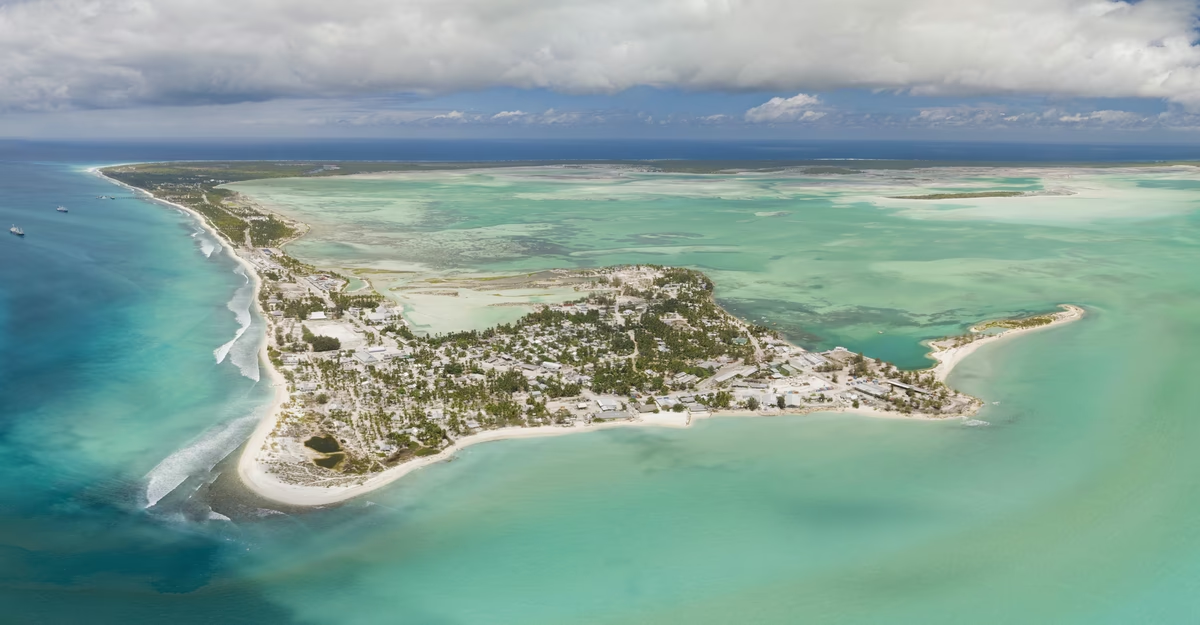
In the middle of the Pacific Ocean, along the equator, scientists monitor a vast rectangular region known as Niño 3.4. Covering an area roughly two-thirds the size of China, the mostly uninhabited zone is tracked by satellites and moored buoys that record tiny changes in ocean temperatures.
When the water in this part of the Pacific rises at least 0.5 degrees Celsius above normal for several months, scientists classify the change as the start of an El Niño phase. That seemingly modest warming can trigger floods, wildfires, droughts and famine around the world.
Right now, Niño 3.4 is exceptionally hot.
“Like a baby pool,” Kristina Tietjen, who spent most of August scuba diving in the middle of this mass of abnormally warm water, told me.
Tietjen has visited Kiritimati, the world’s largest atoll, for more than a decade to study its coral reefs. She typically wears a medium-weight wetsuit while diving, but during this trip her team needed only rash guards. Although this El Niño cycle is still in its early stages—and is expected to be the strongest ever recorded—the waters around Kiritimati have already reached temperatures 3 to 4 degrees Celsius above normal.
El Niño’s impact on Kiritimati’s coral reefs
Tietjen’s work on Kiritimati, pronounced like Christmas, has given her a firsthand view of how repeated marine heatwaves are affecting the atoll’s once nearly pristine tropical coral reefs. During her first El Niño, in 2015–16, 90 percent of Kiritimati’s coral reef died. The ecosystem then experienced years of slow and incomplete recovery.
This month, Tietjen and her colleagues—members of Canadian scientist Julia Baum’s laboratory at the University of Victoria—found that nearly half of the island’s remaining corals had already bleached. Coral bleaching can lead to death if the warming continues.
When Tietjen returns, she may well be swimming over a graveyard.
Most of the world feels El Niño through the ripple effects of heat accumulating in the equatorial Pacific and spreading into the atmosphere and around the globe. In some regions, the phenomenon brings intense rainfall and powerful storms. Elsewhere, crop-killing dry spells can last for months.
Along South America’s Pacific Coast, torrential rain and landslides have temporarily closed a major route to Machu Picchu in Peru, while deadly floods have struck arid areas of northern Chile. India and Ethiopia are experiencing some of their driest summers on record. El Niño generally brings more rain to the southern United States and drier conditions across a band of the northern states.
Strong El Niño events can also produce record-breaking heat. This event is developing in ways unlike any catalogued during the past eight decades. A 2-degree-Celsius rise in the Niño 3.4 region typically earns the label “Super El Niño.” Temperatures have already passed that threshold, and experts expect the warming could peak at roughly twice that level.
“We are now pretty certain this will be an exceptional event,” Malte Stuecker, the director of the International Pacific Research Center at the University of Hawaii at Manoa, told me.
Record ocean temperatures raise global concerns
One reason Stuecker expects the warming to intensify is that equatorial buoys can measure temperatures far below the ocean’s surface. More than 100 meters underwater, a huge mass of warm water has accumulated and is expected to rise toward the surface in the coming months.
The heat building in the ocean has produced a graph in which the current year veers sharply away from historical trend lines, climbing erratically into unfamiliar territory.
Scientists continue to debate how much climate change affects the frequency and strength of El Niño cycles. They agree, however, that these events are now occurring in an ocean warmer than it was in the past.
Last Saturday, the daily global average sea-surface temperature reached 21.1 degrees Celsius (70 degrees Fahrenheit), its highest recorded level, according to Europe’s Copernicus Climate Change Service. Even if El Niño cycles themselves are not changing, their peaks are rising along with the planet’s broader temperature baseline. The result is repeated stress on marine life and disruption to ecosystems that may not be reversible.
Peru’s seabirds face another food crisis
Carlos Zavalaga, director of the seabird laboratory at the Universidad Cientifica del Sur in Lima, began to understand the scale of this year’s warming in mid-June. He had traveled to Macabi and Guanape Norte, two islands off northern Peru, after hearing reports that hundreds of dead birds were washing up along the coasts of Peru and Ecuador.
He had also seen reports of hungry Peruvian pelicans gathering around fish markets in port cities in search of food. The two islands had been crowded with pelicans, Inca terns and Humboldt penguins only a year earlier. When Zavalaga arrived, he found empty nests, including some containing eggs and starving chicks.
“They were abandoned islands,” he told me.
The seabirds feed on anchovies carried by the Humboldt Current, a cold, nutrient-rich upwelling that supports major fisheries along South America’s Pacific Coast. During El Niño years, warmer water moving east across the Pacific displaces the current, causing large schools of anchovies and other feeder fish to disappear from coastal waters.
The decline has been so severe that Peru shut down its anchovy fishery this month. The fishery is a key part of the country’s economy, yet much of the annual quota remained unfilled.
Long before satellite monitoring, Peruvian fishermen observed the cycles of warmer water and declining fish stocks. Because the phenomenon often peaked around Christmas, they named it after the Christ child. References to El Niño appear in Peru’s scientific literature as far back as the 19th century.
Zavalaga has witnessed seabird die-offs during his three decades of research. What concerns him now is the speed and severity of the repeated shocks. Just three years ago—the same year avian flu killed more than 500,000 seabirds—another El Niño struck Peru’s coast.
The birds that had only partially recovered now face another potential die-off.
“It’s like a boxing match: You have a first knockout, you try to recover quickly, and then you have a second knockout,” he said. “I cannot imagine what will be the scenario by the end of this year.”
Zavalaga doubts the birds will become extinct, but some species could move farther south in search of colder waters. Peru’s coastline, along with the culture that depends on its fish and seabirds, could be permanently changed.
Flooding and changing weather on Kiritimati
When warming began around Kiritimati, one of the few populated islands within the Niño 3.4 monitoring zone, resident Bill Newton was struck by how visible the changes were. He told me that the normally dry island became saturated, while recurring floods began washing out roads.
The wet conditions brought swarms of mosquitoes. Previous El Niño events have been linked to outbreaks of dengue and chikungunya. They also brought clouds of dragonflies, which Newton had not seen before. Higher-than-normal tides flooded homes along the coast, while tuna—fish that can thrive in warmer water—attracted dozens of fishing boats offshore.
The prevailing winds also changed direction.
Corals are especially vulnerable to rising water temperatures because they cannot relocate and are highly sensitive to heat stress. According to Baum, whose laboratory includes Tietjen, as little as four weeks in water just 1 degree Celsius warmer than normal can cause bleaching. The process expels the symbiotic algae that provide corals with food and their vivid colors.
Baum has studied Kiritimati’s reef since 2009. After the previous El Niño destroyed nearly the entire reef, she began considering whether she might witness the disappearance of a complete ecosystem during her lifetime.
In a 2018 paper published in Science, Baum projected that repeated bleaching events could become frequent enough to prevent coral reefs from recovering. Reefs typically require roughly 10 to 30 years to recover from mass mortality, and successive bleaching events could arrive before they have time to regrow.
In the years since, Baum had remained hopeful as surviving corals adopted symbiotic algae with greater heat resistance. This year’s warming and the rapid pace of bleaching have erased that hope.
Why this El Niño may change ecosystems permanently
Some of what happens next is predictable. El Niño is not a random force of destruction. It is a warming phase in a defined region of the Pacific that changes the likelihood of particular weather outcomes around the world.
Those probabilities are reliable enough that the U.S. Navy has already scheduled a hospital ship to travel to Peru’s coast in February, positioning it to provide assistance after anticipated flooding.
But Baum and other scientists who study and care for the fragile ecosystems of the equatorial Pacific are discovering that a familiar climate cycle does not guarantee familiar conditions when it ends.