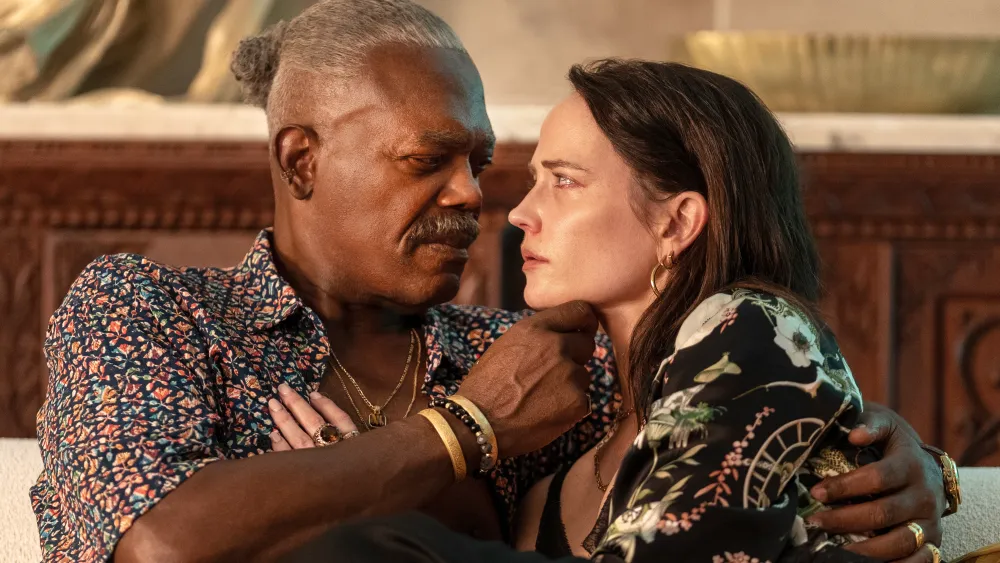
“Just Play Dead” is a convoluted crime comedy that revisits the post-“Pulp Fiction” subgenre of charismatic criminals plotting elaborate, violent schemes with a comedic edge. Screenwriter Dan Gordon, who adapted his own 2016 novel, follows a wealthy criminal who recruits his unfaithful wife to fake his death and defraud a $30 million life insurance policy.
Despite starring Samuel L. Jackson and being directed by Martin Campbell, whose credits include “Casino Royale” and “GoldenEye,” the film feels less like a fully realized crime thriller than a tax shelter—particularly given its production in the Canary Islands. Eva Green, who has often excelled at playing women capable of manipulating men, appears disengaged as the femme fatale at the center of Gordon’s overcomplicated quadruple-cross plot.
A convoluted insurance scam
Jackson plays Jack Wolfe, a criminal hiding in the Canary Islands after an associate is caught with evidence that Jack’s considerable wealth was not acquired entirely legally. For years, Jack has used his wife Nora (Green), a former sex worker, as a “sweetener” in schemes involving other criminals. Nora is delighted by the possibility of Jack going to prison, but their marriage creates a serious legal complication: Jack named her the 51% owner of his estate, meaning she cannot testify against him and could share responsibility if he is indicted.
Jack therefore proposes that Nora help stage his murder, frame someone else and collect the $30 million insurance payout for them to divide. Nora, however, had already started recruiting two potential fall guys: Dani (Eoin Macken), a local police officer in love with her, and Chad (Jason Fernández), a handsome surfer whom she can manipulate through her sexual appeal.
Dani’s partner Bianca (Maria Pedraza) warns him not to become entangled with the wife of a wealthy criminal. Dani pleads with Nora to leave with him but refuses to commit murder. When Chad also rejects the plan, despite his lack of good judgment, Nora blackmails him into taking part. Jack then approaches Chad independently, offering a similar arrangement with a different result: Jack and Chad would split the insurance money while Nora took the blame.
Samuel L. Jackson and Eva Green struggle with the material
With a ponytail that faintly recalls his “Jackie Brown” character Ordell Robbie, Jackson appears unusually relaxed as Jack, a criminal who anticipates every possibility. Unfortunately, that calmness becomes lethargy. Even when given the kind of confident monologues that made him so compelling in Quentin Tarantino’s films, Jackson delivers a largely somnambulant performance.
Green fares no better in a role that should suit her. Nora is supposed to be an alluring and calculating vixen, but Green’s impatient, unconvincing performance makes the character seem disconnected from every scene. Costume designer Irina Kotcheva dresses her in a succession of strappy, skin-tight outfits that recall Nora’s past as a call girl, rather than giving her the tropical wardrobe expected of a wealthy trophy wife in the Canary Islands.
The exchanges between Jack and Nora become tedious quickly. Their counterparts—Dani, Chad and Bianca—are neither intelligent nor sympathetic enough to maintain interest in the increasingly tangled plot. Fernández also struggles to settle on a consistent accent, shifting between a flat Southern California surfer drawl and something more exotic. The inconsistent accents weaken the film’s sense of place, while Pedraza, the closest thing to a local performer, barely conveys that connection. Nicole Ansari Cox’s appearance as a nun who is also the film’s most capable police officer only raises further questions about the island’s law-enforcement recruitment practices.
Martin Campbell delivers polished visuals but little suspense
Although the disastrous “Green Lantern” damaged Campbell’s standing in Hollywood—unfairly, since the film’s failures were not primarily his fault—he still creates the glossy visual style seen in two of the most popular post-Sean Connery James Bond films. “Just Play Dead” looks far more polished than its basic-cable or streaming-oriented premise would suggest, though the Canary Islands locations are so striking that almost any competent filmmaker could capture beautiful images there.
Campbell’s reunion with Green also fails to recreate the simmering chemistry she shared with Daniel Craig in “Casino Royale.” The director’s skills remain more evident in 2022’s Liam Neeson thriller “Memory” and last year’s “Cleaner,” both of which better demonstrate what he can still do.
Instead, “Just Play Dead” feels derivative of “Pulp Fiction” and “Get Shorty,” recalling the uninspired copycats that helped bring that crime-comedy cycle to an end. The first film it most strongly evokes is the poorly received 2004 Elmore Leonard adaptation “The Big Bounce,” which is hardly a recommendation.
“Just Play Dead” review: A crime comedy not worth the risk
It is difficult to determine whether “Just Play Dead” is meant to be an earnest crime comedy or, like its characters’ schemes, a cover for questionable financial arrangements. The production lists six credited producers, three co-producers, four associate producers and 24 executive producers—more credited producers than speaking roles.
Whatever the explanation, the film is a sinkhole for the audience’s time and the producers’ money. Viewers would be better served revisiting almost any of the older films that inspired it—yes, even “The Big Bounce”—than spending time with this unwieldy and forgettable crime caper.
Source: variety.com