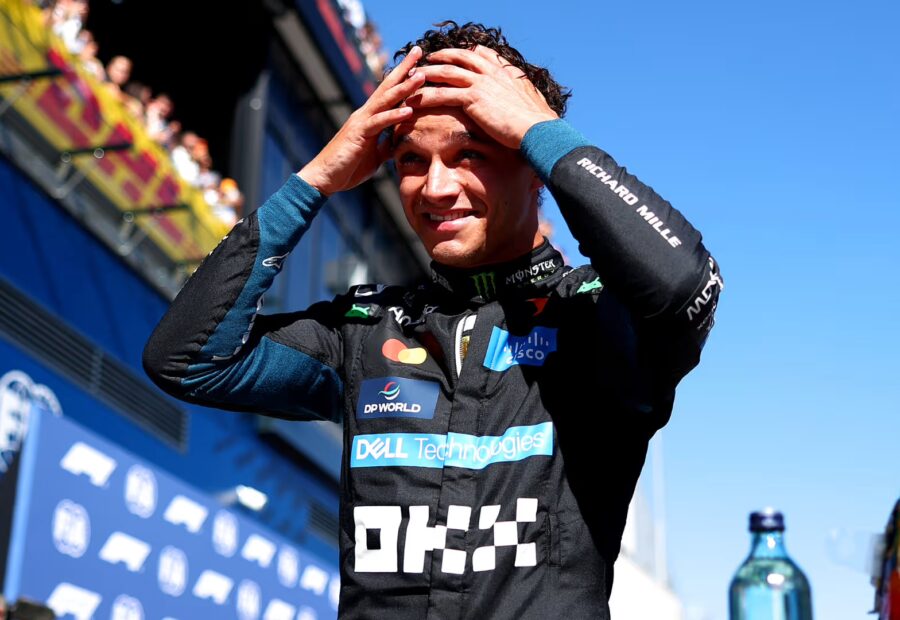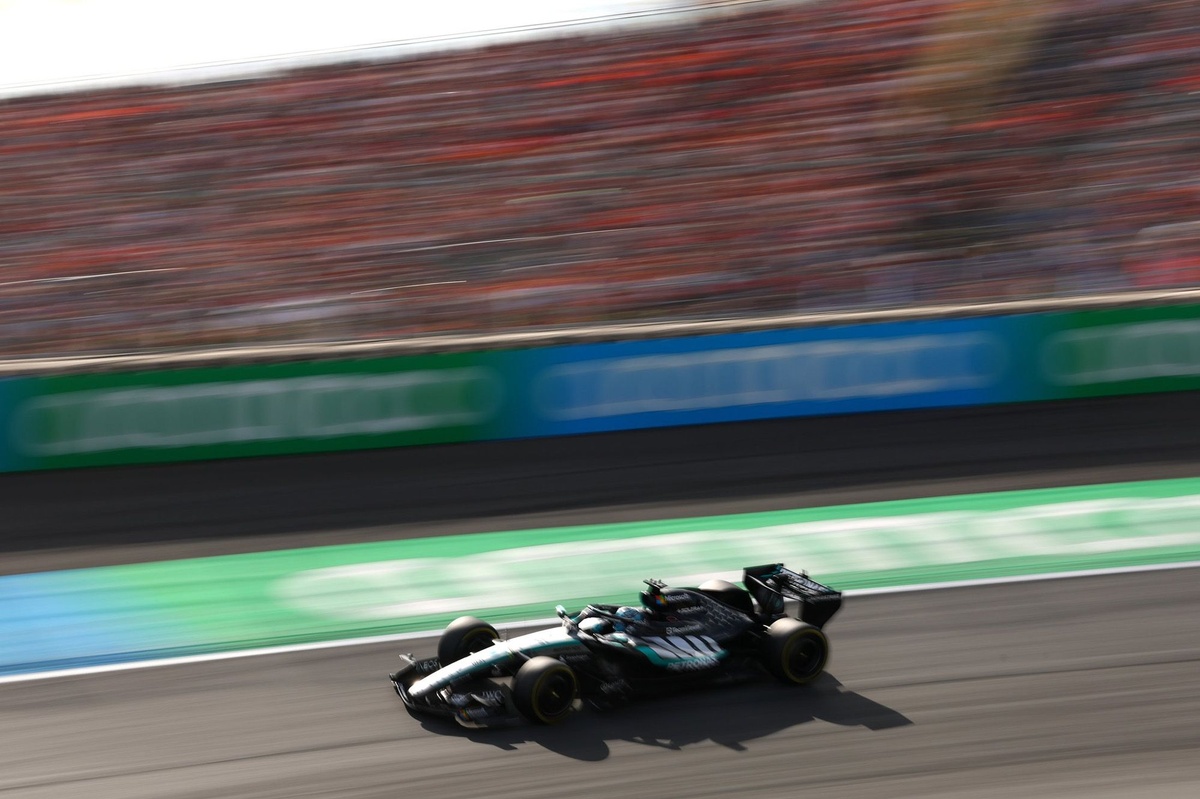
Mercedes trackside engineering director Andrew Shovlin described the team’s performance through Zandvoort’s high-speed corners as “rubbish” as Mercedes investigates its inconsistent pace during the Formula 1 Dutch Grand Prix.
Mercedes made a strong start to the Zandvoort weekend, with George Russell taking pole position and winning the sprint race. However, the team fell behind McLaren’s Lando Norris, who secured pole and victory in the Dutch Grand Prix.
Mercedes still finished second and third in qualifying and the race. Kimi Antonelli finished ahead of team-mate Russell to extend his championship lead to 59 points, but Mercedes was unable to explain why its early pace failed to carry through the rest of the weekend against its main rival.
“We’ve got a few things on the performance side to try and dig into,” Shovlin said on Mercedes’ Nu Silver Arrows Radio Show. “We’re going to be getting on with that this week and see what we learn.
“But there were a few corners where we were pretty rubbish, like that combination of [Turns] 7, 8, 9. You could see [it in] the faster-speed [curves]. And it also gives the tyres on the left-hand side of the car a tough time. And we don’t really understand yet fully what’s causing that.
“We’ve got some ideas, but that’s not a problem that we’ve suffered with so far this year. And there’s plenty of circuits that have got kind of continued corners in one direction.
“We were a bit off the pace in the fastest of those [turns]. And then our problems kind of grew a bit as we went through. All the other corners look solid.”
Mercedes struggled to explain differing tyre performance
Mercedes’ confusion was compounded by the limited changes made to the cars between the sprint race and the grand prix, as well as during the race itself. Shovlin acknowledged that pace can vary depending on tyre compound and tyre life, but both drivers experienced problems at different stages of the race.
“We didn’t change the car. We obviously had different compounds at different stages. But again, we need to understand a bit,” he said.
“George’s first stint was a bit lacklustre compared to his later ones. And then with Kimi, first stint was good, and then dropped a bit on the second, dropped a bit more on the third, a bit came back on the third. It wasn’t like we were playing around with electronic settings or up and down on flap angles. And for him, the balance of the car was quite different stint on stint.
“The two drivers, normally they report similar things with a car at the end of the race. Both of them, their perception of the balance, and probably the reality is George had a more understeery car, Kimi had a more oversteery car. If we look at how they were set up, we don’t yet know quite why we got such a big difference.
“So, though, really good to have a strong point-scoring weekend when we weren’t at our best in terms of performance. It was actually good fun, sat on the pitwall and having to make decisions in a hurry. I think the whole team enjoyed that and rose to the occasion. And it was definitely a good result, given where we were.
“But yeah, a bit of head-scratching to do over the next few days.”
Mercedes records second-highest points haul of the season
Despite its lack of clarity over the pace loss, Mercedes scored 46 points at Zandvoort, its second-highest team total of the season. Only its 55-point haul at the Chinese Grand Prix was higher, although both events were sprint weekends with more points available.