
Two major financial trends are converging in the artificial intelligence sector: private credit for AI infrastructure spending and the tokenization of real-world assets (RWAs).
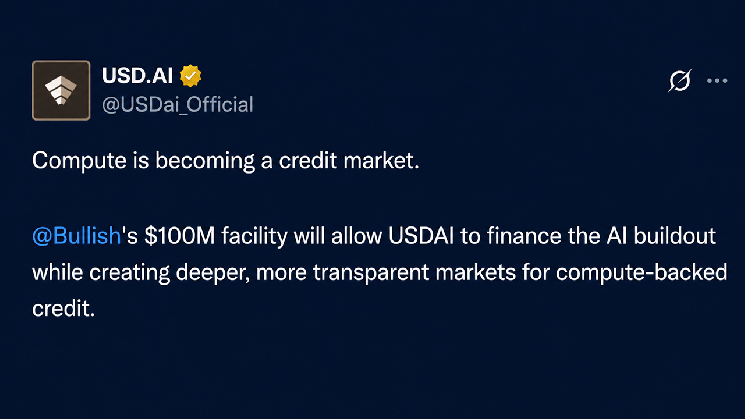
Bullish, a New York Stock Exchange-listed institutional crypto platform and the parent company of the news publication Coindesk, announced this week that it is lending $100 million to USD.AI. The financing will support loans to businesses developing AI systems and related infrastructure.
Under the model, AI companies use valuable graphics processing units (GPUs) as collateral. Bullish says the market for this emerging form of lending is substantial and larger than several established borrowing categories.
“Bullish is targeting a capital-intensive sector that has rapidly emerged as one of the largest in private credit, with a scale that eclipses legacy debt markets such as auto loans and home equity lines of credit (HELOCs),” the company said.
Bullish Expands Its Real-World Asset Strategy
Block.one co-founder and CEO Brendan Blumer established Bullish in Hong Kong in 2020. Following Friday’s announcement, Bullish shares fell 2% on the NYSE. However, the stock was up 10.5% over five days and had gained more than 44% over the previous month.
Thomas Cowan, Bullish’s head of tokenization, said the company believes physical assets should be connected to digital financial systems. He described the USD.AI transaction as an example of that strategy.
“Our commitment to USD.AI reflects a conviction we’ve believed since our first investment in the protocol: that credible, well-structured real-world assets belong onchain,” Cowan remarked. “USD.AI’s onchain transparency gave us the visibility to underwrite this facility with the same institutional diligence we apply across our platform, and backing it is a meaningful step toward bringing tokenized assets to institutional scale.”
GPU-Backed Loans Face a Major Risk Test
GPU-backed lending also carries significant risks. Hardware prices can fall rapidly, while GPUs may become obsolete soon after more advanced models reach the market.
As of Saturday, Aug. 29, 2026, GPU prices remained high, particularly for Nvidia consumer graphics cards with larger amounts of video memory. Valuations had also risen again during the summer rather than easing.
The model’s most important test will come if a borrower is unable to repay its loan. In that scenario, lenders will need to determine how much value the pledged GPUs retain and how quickly they can be sold.