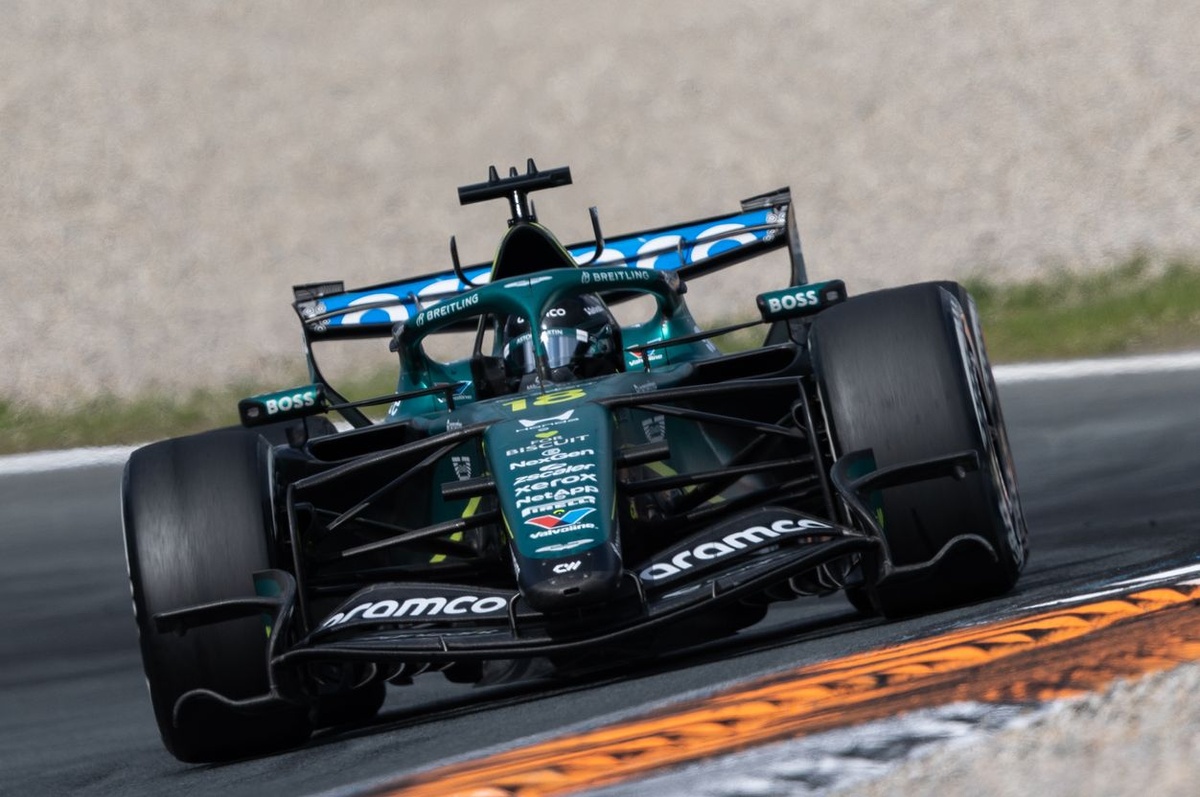
Mike Krack says Fernando Alonso’s ninth-place finish at the Formula 1 Dutch Grand Prix was helped by Zandvoort’s track characteristics, while Aston Martin continues to unlock the full potential of its upgraded AMR26.
After qualifying 18th, Alonso used an opportunistic one-stop strategy to claim an unexpected ninth place, finishing ahead of a frustrated Pierre Gasly.
Zandvoort suited Aston Martin’s cornering performance
Most drivers made two pit stops, but Aston Martin needed to adopt an out-of-sync strategy to benefit from the AMR26’s speed through the corners. The Honda-powered car recovered the time it lost on the straights by performing strongly in the circuit’s slower sections.
Asked whether Aston Martin’s race pace was stronger than its qualifying pace, the team’s chief trackside officer agreed, while warning that less favourable circuits such as Monza and Baku were next on the calendar. Both venues feature some of Formula 1’s longest straights.
“Since Budapest we know that we’re a bit stronger in the race,” Krack said. “I think Fernando said today our result will depend more or less on how long the straights are.
“So these were now two races where the straights were a bit on the short side. So we will have tougher races to come, but I think that this is part of the game. You have races where you’re strong, and you have races where you’re less strong. So it will be interesting to see how the rest of the season goes.”
Photo by: Alex Bierens de Haan / LAT Images via Getty Images
Aston Martin still learning how to use its upgrades
Aston Martin recorded the second-lowest straight-line speed during qualifying at Zandvoort, reaching 309.5km/h. That was significantly slower than Alpine’s 331.7km/h and only marginally faster than Cadillac’s 309.4km/h.
The deficit came despite the arrival of Honda’s long-awaited power unit upgrade, which was expected to deliver a substantial performance improvement after the car suffered severe problems earlier in the season. However, the team has made visible progress with the chassis, as demonstrated again in the Netherlands.
“We get to know this package more and more,” Krack said. “With the large package that we introduced in Budapest, it will take some sessions to learn how to deal with it and to learn how to set it up. And the same goes actually also for the introduction of the power unit now.
“We need to learn how to use it, we need to learn how to optimise it, and I think it’s going to take us a couple of events, but it was a good step forward.
Alonso and team-mate Lance Stroll both made positive comments over the team radio during the weekend. Krack said those remarks reflected Aston Martin’s growing understanding of its latest package, while acknowledging that the team could not extract its maximum performance in every session.
“It goes along with what I said in terms of trying to understand the package. If you have changes at this large scale, with the intensity of the sessions, it’s always difficult to get the maximum out of it all the time. And the more sessions we get, the more we will get it under control.
“But there will always be sessions where you will have a bit more difficulties, some others where it will be easier, and we had quite a good configuration this weekend.”