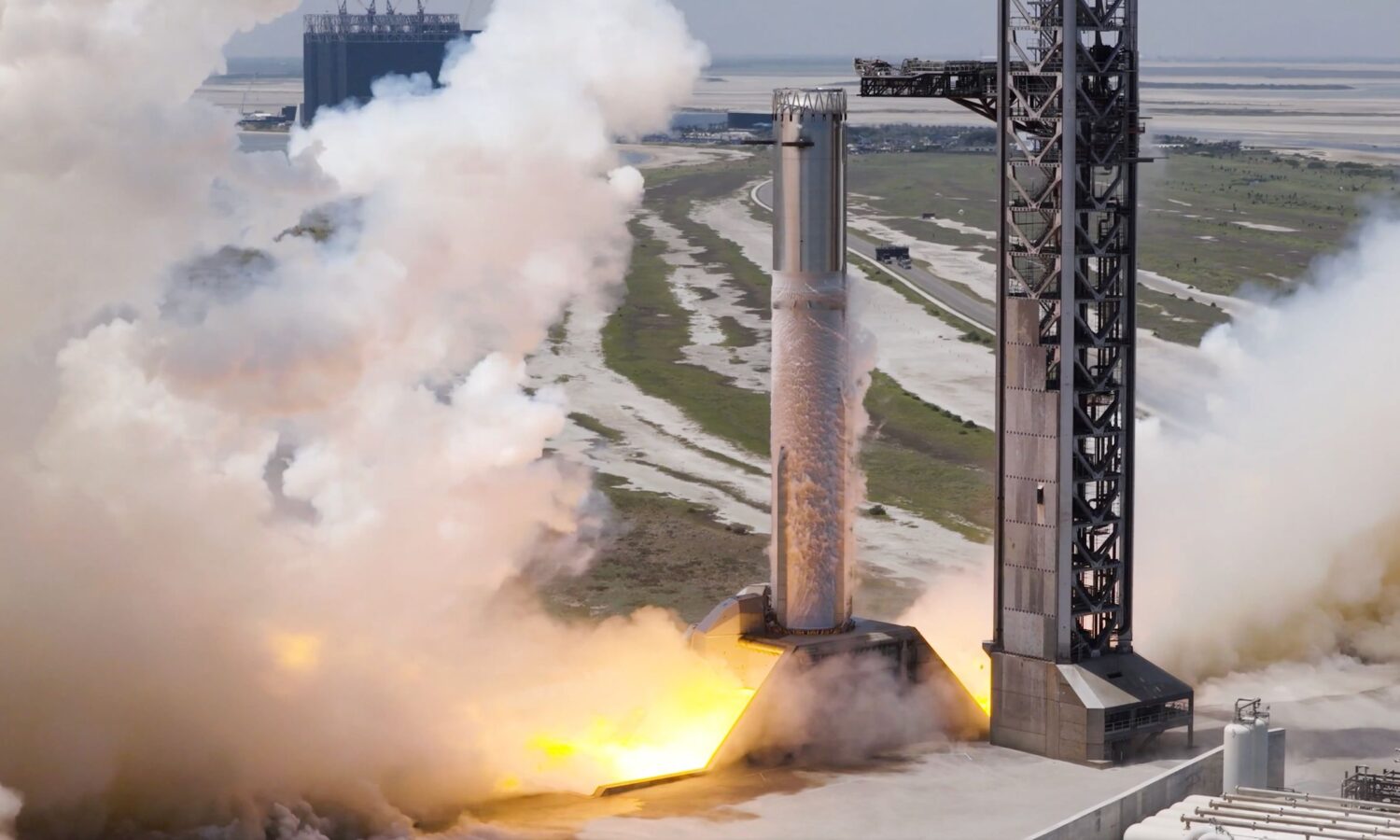
SpaceX has completed another major test ahead of Starship Flight 14, firing all 33 engines on the rocket’s massive Super Heavy first-stage booster at the company’s Starbase facility in South Texas on Friday (Aug. 28).
“Full duration 33-engine static fire with the Super Heavy booster preparing for Flight 14,” SpaceX wrote in a Friday X post accompanying two videos of the test.
Starship Flight 14 preparations
The test marks an important step toward the 14th flight of Starship, SpaceX’s fully reusable megarocket. The vehicle consists of the Super Heavy booster and a 171-foot-tall (52-meter) upper stage called Starship, or Ship.
SpaceX has also tested the engines on Flight 14’s Ship, firing all six engines at Starbase last week.
The company is believed to be targeting mid-September for Flight 14, which is expected to be a major milestone in Starship’s development: the vehicle’s first-ever orbital mission. Ship may also deploy operational payloads during the flight, including a batch of SpaceX’s next-generation “Version 3” Starlink satellites.
During Flight 13 last month, Ship successfully deployed 20 V3 Starlink satellites on a suborbital trajectory. The satellites later fell back to Earth.
NASA’s plans for Starship
Starship is the largest and most powerful rocket ever built. Both Super Heavy and Ship are designed for full and rapid reuse, and SpaceX believes the vehicle could transform spaceflight by helping humanity extend its presence throughout the solar system.
NASA is also relying on Starship for its lunar exploration plans. The agency selected Ship as a crewed lunar lander for the Artemis program, which aims to establish a base near the moon’s south pole in the coming years.
If SpaceX’s plans remain on schedule, Ship will fly on NASA’s Artemis III mission to Earth orbit in mid-2027 and carry astronauts to the moon during Artemis IV in late 2028. NASA has also selected Blue Origin’s Blue Moon as a second crewed Artemis lander, which could fly on one or both of those missions.
Source: www.space.com