
7 F1 Drivers Who Staged Remarkable Comebacks After Stellar Substitute Performances

The final Dutch Grand Prix at Zandvoort delivered a major talking point: Yuki Tsunoda’s return to a race seat with Racing Bulls. After losing his Red Bull drive following a difficult 2025 campaign, the Japanese driver had been relegated to test and reserve duties. He seized the chance to stand in for Liam Lawson, who had himself been promoted to the senior team to cover for an injured Isack Hadjar. Tsunoda finished a strong eleventh, just shy of the points.
“I did everything I could today and I really enjoyed it,” Tsunoda said after just missing out on points in P11. Whether the performance earns him a full-time grid return remains to be seen, but Formula 1 history offers several precedents where a standout substitute drive reignited a career.
Nico Hulkenberg: The ultimate super-sub

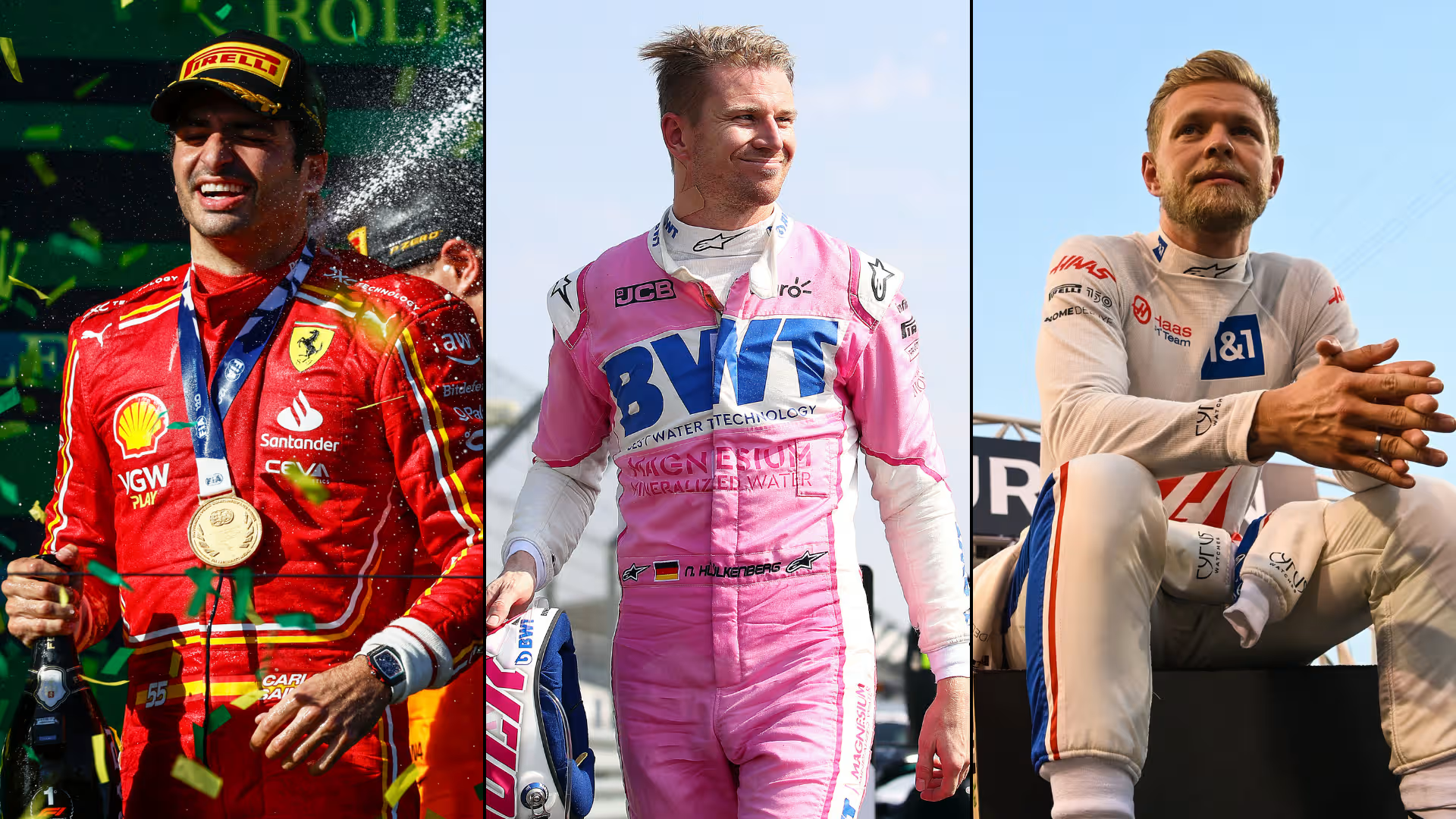
Finishing just ahead of Tsunoda in Zandvoort was Nico Hulkenberg, a driver intimately familiar with the power of a stand-in appearance. After being dropped by Renault at the end of 2019, Hulkenberg made three substitute starts for Racing Point during the 2020 season when Sergio Perez and Lance Stroll contracted Covid-19. A car issue prevented him from starting his first outing at Silverstone, but one week later at the 70th Anniversary Grand Prix he qualified third behind the Mercedes cars and finished seventh. His third appearance at the Nürburgring saw him charge from the back of the grid to eighth place.
Those drives secured him a reserve role for 2021, two further stand-in weekends in 2022, and ultimately a full-time comeback with Haas in 2023. The 39-year-old has since thrived, moving to the then Kick Sauber outfit—now Audi—and scoring a long-awaited maiden podium at the 2024 British Grand Prix.
Carlos Sainz: Turning a forced exit into a victory lap
Unlike Tsunoda and Hulkenberg, Carlos Sainz has not been sidelined in F1, but he entered the 2024 season knowing he would leave Ferrari at year’s end. The blockbuster announcement that Lewis Hamilton would join the Scuderia for 2025 caught many off guard—perhaps including Sainz, who would make way for the seven-time champion. Complicating matters, appendicitis surgery forced him to miss the Saudi Arabian Grand Prix, prompting a memorable substitute debut from then-F2 driver Ollie Bearman.
Sainz returned two weeks later in Australia and produced a stunning comeback: second on the grid and his third career victory. The performance reminded the paddock of his calibre, attracting multiple suitors for 2025 before he signed with Williams.
Alain Prost: Sabbatical leads to a fourth title
Alain Prost’s split with Ferrari was far more acrimonious. After moving from McLaren, his 1990 debut season with the Scuderia ended in controversial title defeat to Ayrton Senna. Tensions escalated in 1991 as Prost publicly criticized the team’s declining competitiveness, leading to his dismissal before the season concluded. With no time to secure a 1992 seat, the “Professor” took a sabbatical.
He returned with Williams for 1993 and announced his intent immediately, converting pole position into victory at the season opener in South Africa. Six more wins followed, delivering his fourth World Championship before he retired at the campaign’s close.
Mika Salo: Filling Schumacher’s shoes at Ferrari
Mika Salo debuted late in 1994 with Lotus and raced for Tyrrell and Arrows before losing his seat for 1999. An opportunity arose when he replaced an injured Ricardo Zonta at BAR for three races, but the bigger call came when Ferrari drafted him to substitute for Michael Schumacher after the German broke his leg at Silverstone.
Despite the daunting task, Salo impressed with ninth on his Ferrari debut in Austria. At Hockenheim one round later, he qualified fourth, led the race, and moved aside for teammate Eddie Irvine—who was battling Mika Häkkinen for the title—to finish second for his first career podium. A second rostrum at Monza helped Ferrari secure the Constructors’ Championship, and Salo’s form earned a full-time Sauber drive for 2000.
Valtteri Bottas: “Bottas 2.0” rises from a dark place
Valtteri Bottas endured a winless 2018 season, dropping to fifth in the standings while teammate Lewis Hamilton claimed a sixth title. The Finn later revealed he contemplated leaving the sport after falling into a “dark place,” but used the winter to regroup. The revival was instant: at the 2019 Australian Grand Prix, he overtook polesitter Hamilton into the first corner and dominated to win by 20 seconds.
Over the radio, he famously declared, “To whom it may concern, f*** you!”—a message he later admitted was “just all the frustration from the year before coming out.” That victory launched his strongest F1 season, yielding four wins and a career-best second place in the Drivers’ Championship.
Kevin Magnussen: The “Viking comeback”
Kevin Magnussen’s return after a year away mirrors the stand-in narrative. After four seasons with Haas (2017–2020), he was replaced for 2021 by rookies Nikita Mazepin and Mick Schumacher. Magnussen competed in other series until a late call from Haas to replace Mazepin for 2022. Despite the hiatus, he qualified seventh on his return in Bahrain and converted it to fifth on race day.
Team Principal Guenther Steiner hailed it as “some f****** Viking comeback.” Magnussen later added a shock pole position in São Paulo and remained with Haas through 2024 before moving to the World Endurance Championship.
Sergio Perez: From seat loss to maiden win and a Red Bull drive
Sergio Perez has raced in F1 since his 2011 Sauber debut, spending 2013 with McLaren before joining Force India. His future turned uncertain when Sebastian Vettel signed for the team’s 2021 rebrand as Aston Martin, leaving Perez without a contract. He responded emphatically: a second place in Turkey for Racing Point, followed by a spectacular maiden victory in Sakhir after a first-lap incident dropped him to the back of the field.
The win made him the first Mexican driver to win since Pedro Rodriguez in 1970. That recovery drive undoubtedly strengthened his case for a 2021 seat, leading to a four-year tenure with Red Bull.
Each of these drivers turned a moment of uncertainty—whether a substitute appearance, a forced sabbatical, or a sudden seat loss—into a career-defining resurgence. Tsunoda’s determined drive at Zandvoort suggests he may yet join their ranks.




No Comments