
Moving Self-Custody Bitcoin to Wall Street Now 25 Times Easier, $5 Billion Already Transferred

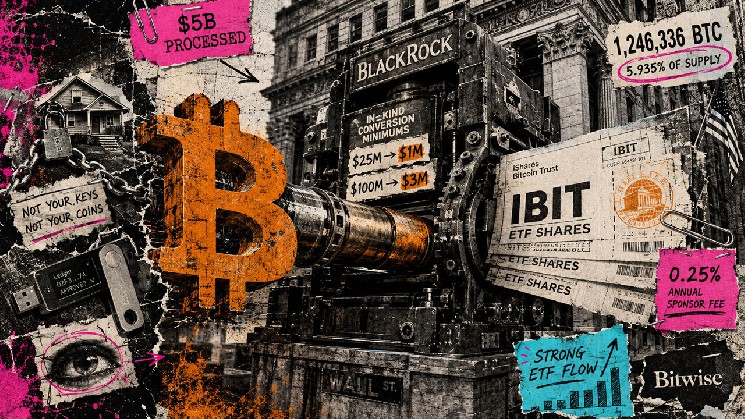
BlackRock and Bitwise Slash Minimums for In-Kind Bitcoin-to-ETF Conversions
BlackRock has reduced the minimum transaction size for converting privately held Bitcoin into shares of its iShares Bitcoin Trust (IBIT) from $25 million to $1 million, a 96% cut confirmed to Bloomberg in July. Bitwise followed with an even steeper reduction, lowering its floor from an initial $100 million to $50 million and now to $3 million—a 97% total decline. While the dollar thresholds still exclude most retail investors, the moves signal a structural shift: institutional custody is evolving from a niche whale service into a repeatable wealth-management product.
In-Kind Creation Removes Friction and Potential Tax Events
The mechanics rely on in-kind creation, a process the SEC approved for crypto exchange-traded products (ETPs) in July 2025, ending the original cash-only restriction. An eligible holder transfers Bitcoin through an authorized participant; the trust issues ETF shares at settlement, and the intermediary credits those shares to the holder’s brokerage account. This compresses what was previously a multi-step sequence—selling Bitcoin, wiring dollars, and repurchasing ETF exposure—into a single institutional transaction.

The efficiency gain is more than operational. Selling Bitcoin can realize a taxable gain, while in-kind transactions may defer that gain for some holders. Because the tax outcome depends on the holder’s legal structure, each conversion requires individual tax advice. BlackRock says the program has already processed more than $5 billion in conversions to date.
Wealth-Management Channels Expand Access
A referral program announced in June by Morgan Stanley and Galaxy illustrates how the workflow is embedding into wealth management. Eligible clients lend crypto to Galaxy, which coordinates an in-kind creation with an authorized participant before ETF shares arrive in the client’s chosen account. Galaxy cut its minimum for referred clients from $25 million to $5 million and said onboarding that can exceed four weeks may be shortened by up to 75%.
Activity data underscores the trend. Grayscale completed 62% of its gross Bitcoin creations in kind in June, up from 28% in March. At 21Shares, completed transactions averaged about $5 million over the three months through July, according to Bloomberg.
US Spot Bitcoin ETFs Now Hold Nearly 6% of Total Supply

Institutional adoption is measurable on-chain. As of August 25, US spot Bitcoin ETFs collectively held 1,246,336 BTC across 13 funds, equal to 5.935% of the 21 million supply, per Bitbo. IBIT alone held 765,389.9 BTC (3.645% of supply), with BlackRock reporting net assets of $60.65 billion on the same date.
Physical Security Risks Drive Custody Reassessment
BlackRock’s head of digital assets, Robbie Mitchnick, told Bloomberg that kidnappings, ransom demands, and custody failures can motivate holders to move some or all of their coins into an ETF. The company has not broken down the $5 billion in conversions by motive, so the crime data provides environmental context rather than direct causation.
The physical threat is quantifiable. Chainalysis documented 46 violent crypto incidents through late June 2026, estimating attackers successfully stole more than $30 million in the first half of the year—already over half of 2025’s record $58 million. Only 12 of the 46 attempts produced a payment. CertiK counted 52 verified incidents in the same period, up 33.3% year-over-year, with $124.1 million in recorded exposure (a broader measure including losses and ransom demands). Home invasions jumped from one to 20 incidents year-over-year, while kidnappings rose from 12 to 16.
Self-custody removes intermediaries from the authorization chain, leaving the holder as the final signer. A properly secured wallet resists remote theft, but a criminal inside the home can target the person who controls the seed phrase, hardware device, or second multisig signer. The true cost of self-custody therefore extends far beyond a hardware wallet: multisig coordination, inheritance planning, private security, reporting, and recovery all consume capital or attention. BlackRock describes IBIT as a way to simplify the operating and custody complexity of direct ownership.
Trade-Offs: Sponsor Fees and Concentrated Custody
IBIT carries a 0.25% annual sponsor fee and depends on brokerage and market infrastructure. The owner holds a security tracking Bitcoin’s price while the fund’s custodians retain the coins. Direct custody preserves the ability to withdraw, transfer on-chain, and verify assets in a personal wallet.
Moving coins into ETFs reduces individual key risk but concentrates Bitcoin inside a smaller set of institutional firms. CryptoSlate calculated in April that funds naming Coinbase as a custodian or primary custodian represented 84.1% of US Bitcoin ETF assets under a broad method; a stricter count excluding multi-custodian funds with undisclosed allocations still reached 80.8%, or about $74.06 billion. Those percentages describe funds connected to Coinbase in some custody capacity; exact allocations among providers remain undisclosed.
The custody map is diversifying. BlackRock’s documents name Anchorage as an available additional custodian. ARK lists Coinbase alongside BitGo and Anchorage. Fidelity uses its own digital-asset subsidiary, and VanEck uses Gemini. The market can therefore move more coins into institutional custody while distributing them among more providers.
Parallel Demand Channels: Fresh Capital and Existing Coins
The conversion program is widening amid a fresh burst of ETF demand. Farside data show US spot Bitcoin ETFs absorbed $2.57 billion across seven positive sessions from August 17 through August 25, with IBIT capturing $1.82 billion (71% of the total). Daily net inflows and direct Bitcoin conversions measure different activity and belong in separate datasets, but together they show two routes operating simultaneously: new capital buying ETF shares while existing coin holders gain a cheaper path to place Bitcoin they already own inside the same funds.
Self-Custody Remains an Option as Institutional Packaging Gets Cheaper
Bitcoin’s protocol still lets holders control an asset that can move anywhere the network reaches. Wealthy owners can continue paying for the security, coordination, and recovery systems that direct control requires. Wall Street now sells Bitcoin price exposure in a conventional account and assumes much of that operational burden for qualifying clients. The self-custody option stays available as the fund industry cuts the entry price for its packaged solution by 96% at BlackRock and 97% at Bitwise. More than $5 billion has already passed through IBIT, demonstrating how institutional adoption advances through coins leaving private wallets alongside dollars arriving from buyers who never held Bitcoin.






No Comments